
Table of Contents
Preserving Your Property with Professional Tuckpointing
Understanding the value of sound mortar joints is essential, and finding the right tuckpointing near your property is the first step toward lasting protection. At B&G Tuckpointing, we combine two decades of masonry experience with a commitment to quality that extends nationwide. According to the Brick Industry Association, proper maintenance of mortar joints is critical for preventing water penetration and structural decay.
Tuckpointing is the targeted repair of deteriorated mortar, a process that restores both the structural integrity and weather resistance of your brickwork. Professional tuckpointing near you uses color-matched mortar and precise techniques to seamlessly blend with existing brick, preserving aesthetics while reinforcing the wall. The International Masonry Institute emphasizes that such restoration demands skilled labor to ensure long-lasting results. Neglecting these joints allows water infiltration, leading to freeze-thaw cycles that can cause severe and costly damage.
When considering your options, it helps to understand the difference between repointing vs tuckpointing. Repointing typically involves the full removal and replacement of mortar to a consistent depth, while spot tuckpointing targets only the damaged sections. While some may worry about brick masonry repair cost, we believe an accurate, fair quote can only be given after an expert assessment. Our specialized tools and experience stand in stark contrast to DIY attempts that often lead to mismatched mortar and incomplete protection.
We aim to enhance the appearance and improve the integrity of your house or building. For a personalized plan, please submit a tuckpointing service inquiry through our website. Now that you understand how professional service preserves your property, let’s explore the specific services we provide across the nation.
Understanding Tuckpointing and Repointing: Key Differences and When You Need Them
Now that you understand why mortar joints matter, let’s explore the two main techniques used to restore them. If you’re searching for tuckpointing near me in St. Louis, it’s essential to know the difference between these methods. Choosing the right one significantly affects your brickwork’s durability and appearance, and we’re here to guide you through the process.
The Difference Between Tuckpointing and Repointing
When you hear the terms repointing vs tuckpointing, the main distinction is aesthetic. Repointing is a standard repair. It involves fully removing damaged mortar and refilling the joints with new, matching mortar. This restores the wall’s structural integrity without creating a decorative effect. The goal is a clean, uniform look. Tuckpointing, however, goes a step further. After the initial repointing, we cut a fine groove in the new mortar and fill it with a contrasting color. This creates the illusion of perfectly thin, precise joints. If you’re looking for both strength and beauty, our solid tuckpointing service delivers lasting results with a decorative finish.
The following table provides a quick overview of these two popular brick repair techniques.
| Aspect | Tuckpointing | Repointing |
|---|---|---|
| Technique | Removes damaged mortar, applies new mortar, then cuts a fine groove and fills it with a contrasting color to simulate thin joints | Removes damaged mortar and replaces it fully with matching mortar; no decorative groove |
| Primary Purpose | Restore structural integrity while enhancing aesthetic appearance with simulated fine joints | Restore structural integrity by replacing deteriorated mortar |
| Ideal For | Historic buildings, curb-appeal-focused homes, and facades where visual precision matters | General mortar repair where matching the original look is sufficient |
| Cost Consideration | Higher due to additional labor and detail work; premium results | Generally lower; standard work with less labor intensity |
| Moisture Protection | Excellent when done correctly; the tight groove and sealant layer add extra barrier | Very good; proper repointing restores the wall’s water-shedding ability |
| Aesthetic Outcome | Highly decorative; creates illusion of perfectly uniform, thin mortar lines | Clean, uniform but does not create the illusion of thin joints |
Choosing between these two often comes down to your goals. If your main concern is stopping leaks and stabilizing bricks, repointing is a practical and effective solution. However, for a historically accurate restoration or a dramatic curb-appeal boost that only premium joint refinishing can provide, tuckpointing is the superior choice.
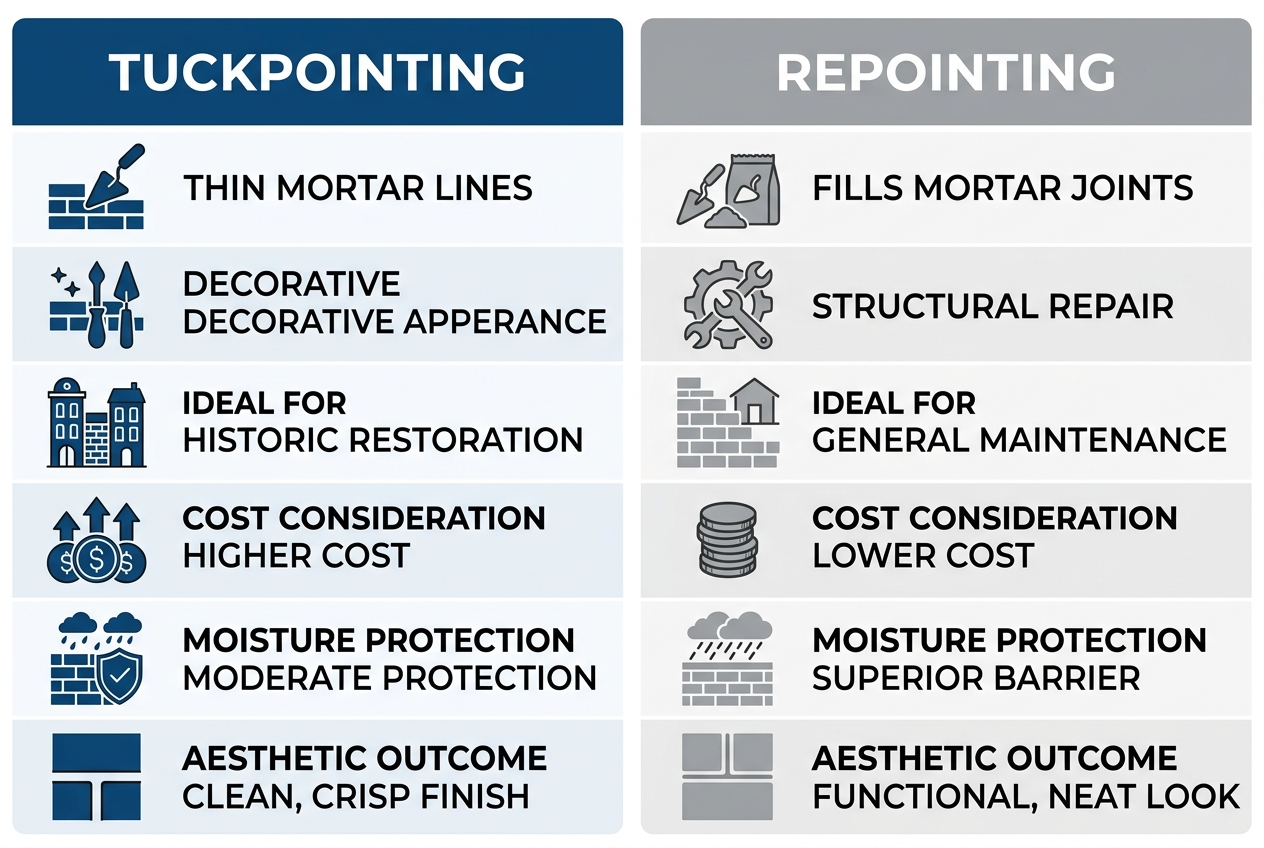
Side-by-side comparison of tuckpointing versus repointing techniques
Signs Your Masonry Needs Professional Attention
Your brickwork will tell you when it’s in distress. The most common warning sign is cracking in the mortar itself. You might also see crumbling or powdery mortar, indicating it has lost its binding strength. A white, powdery substance on the brick surface, known as efflorescence, signals that moisture is moving through the wall and depositing salts. Finally, water stains or persistent dampness on interior walls near the chimney or at corners often point to failing mortar joints. We recommend you don’t ignore these indicators, as they tend to worsen rapidly.
How Often Should You Inspect Mortar Joints?
According to the Brick Industry Association, we advise a thorough inspection of your property’s masonry at least once a year. An annual check-up helps catch minor issues before they become major structural problems. You should also perform a visual scan after any bout of severe weather. Freeze-thaw cycles are especially damaging, as water expands inside tiny cracks, accelerating deterioration. Regular assessments, particularly for older homes, are the best defense against costly foundational damage down the line.
Longevity of Professional Tuckpointing Repairs
The International Masonry Institute notes that the lifespan of properly executed mortar joint restoration can be remarkable. When done by skilled professionals using the correct mortar mix, high-quality tuckpointing repairs can easily last 20 to 50 years or more. Several factors influence this longevity, including the quality of the workmanship, the specific materials chosen to match your historic brick, and the level of weather exposure the wall endures. This makes the initial brick masonry repair cost a worthwhile investment in your home’s long-term health. For a tailored approach, B&G’s mission is to provide residential and commercial customers with an outstanding level of service. We aim to enhance the appearance and improve the integrity of your house or building.
Armed with this knowledge, you can decide which approach fits your home–and B&G is here to help. Our solid tuckpointing service delivers both structural integrity and curb appeal. Get a quote to discuss your project.
Key Benefits of Professional Tuckpointing for Your Property
Now that you understand what tuckpointing is, let’s explore the key benefits for your property. If you’re searching for tuckpointing near me, you’re likely noticing signs of mortar deterioration and want to understand the value of professional restoration. At B&G Tuckpointing, we aim to enhance the appearance and improve the integrity of your house or building through expert masonry care.
Enhanced Structural Integrity and Water Protection
Deteriorated mortar joints are more than an eyesore; they are the primary entry points for moisture that can compromise your entire wall system. While repointing vs tuckpointing is often confused, professional tuckpointing specifically recreates the original look of mortar joints while replacing the old, crumbling material with fresh, durable mortar. This process directly reinforces the masonry by sealing gaps that allow water infiltration. According to technical guidelines from the Brick Industry Association, properly tooled and cured mortar joints are essential for preventing water penetration and subsequent freeze-thaw damage, which can cause bricks to crack and spall. Neglecting these joints can lead to costly structural issues, but professional restoration significantly extends the life of your masonry by maintaining its compressive strength and weather resistance. The International Masonry Institute emphasizes that best-practice tuckpointing is a critical investment in a building’s longevity and performance.
Curb Appeal and Property Value
Beyond protection, tuckpointing also dramatically enhances your property’s visual appeal. Professional tuckpointing–including spot tuckpointing and color matching–can restore crisp, uniform mortar lines that transform a weathered, neglected facade into a well-maintained showpiece. This aesthetic transformation creates a powerful first impression, significantly boosting curb appeal. For homeowners considering selling, this improved exterior can translate directly into increased resale value and make the property far more attractive to potential buyers. A building with sharp, clean mortar lines signals to everyone that the property has been meticulously cared for, inside and out.
Cost-Effectiveness and Return on Investment
When evaluating brick masonry repair cost, tuckpointing offers a more budget-friendly alternative to full replacement. Full wall replacement is a massive undertaking that involves demolition and complete reconstruction, a process that is exponentially more expensive and disruptive than carefully removing and replacing only the damaged mortar. Tuckpointing addresses the root cause of deterioration at a fraction of the cost, delivering an exceptional return on investment. Instead of a complete rebuild, this targeted restoration arrests decay and prevents the kind of extensive damage that leads to major structural repairs. The final cost is influenced by several factors, including the extent of the damage, wall accessibility, and the building’s height. We Service Tuckpointing Clients Nationwide and provide a custom quote tailored to your project’s specific needs, ensuring you get a precise, no-obligation estimate.
Financing and Remote Estimates for Hassle-Free Planning
We understand that restoring your property is a significant decision, which is why we’ve made the planning process as convenient as the work itself is essential. To make your investment budget-friendly, B&G offers hassle-free in-house financing options, allowing you to proceed with necessary repairs today and manage the cost over time with a plan that fits your budget. Furthermore, you don’t even need to schedule an on-site visit to get started. Our streamlined, photo-based remote estimate process lets you get a professional assessment simply by submitting images through our quote portal. B&G’s mission is to provide residential and commercial customers with an outstanding level of service, from the first quote to the final brick. Ready to protect and beautify your property? Get A Quote today and let our two decades of experience work for you.
The Tuckpointing Process: From Assessment to Completion
If you’ve been searching for tuckpointing near me, you’re likely curious about what the work involves before inviting a crew onto your property. We understand that transparency builds trust, so we want to walk you through every stage of our proven restoration method. B&G’s mission is to provide residential and commercial customers with an outstanding level of service, and that starts with a clear, well-defined process from the moment you reach out. We aim to enhance the appearance and improve the integrity of your house or building, and this guide shows you exactly how we do it. From your first inquiry to our final quality check, our team follows precise steps that combine two decades of hands-on experience with industry best practices.
Initial Assessment and Remote Estimation
We begin with a comprehensive evaluation of your masonry to determine the needed scope of work, which you can start without ever scheduling an on-site appointment. Our user-friendly online portal lets you upload clear photos of the damaged mortar joints, brick faces, and any areas of concern. Our experts then review these images to assess the severity of deterioration and identify whether the restoration requires only tuckpointing or more extensive structural work. This remote estimation provides a custom quote for your brick masonry repair cost — no on-site visit needed — giving you a clear, no-obligation picture of the investment before we mobilize our crew.
Mortar Selection and Color Matching
Once we finalize the assessment, our focus shifts to an often-overlooked but critical step: sourcing and blending the perfect mortar. We test both lime-based and cement-based mortar blends to determine which formula best complements the age and composition of your original brickwork. This distinction matters, especially when clients ask about repointing vs tuckpointing; while repointing fills the joint flush, tuckpointing adds a decorative groove for a crisp, original look that demands a precise match. Our crew mixes small sample batches, applies them to an inconspicuous spot or a spare brick, and allows them to cure so we can verify the color, texture, and finish against the existing wall before proceeding.
Precision Removal and Application
With the mortar selected, our crew carefully grinds out the old, failing mortar using diamond-blade saws or angle grinders, cutting each joint to a consistent depth of roughly two-thirds of the brick’s thickness. We take extreme care to avoid chipping or scarring the brick edges, working methodically across the wall to ensure uniform preparation. After clearing the dust and debris, we begin applying the new mortar in thin lifts or layers, especially when joints are deep, waiting a set time between applications for proper adhesion and compaction. If bricks are severely damaged, we may recommend brick rebuilding and relaying as part of the restoration before continuing. Once the joint is filled flush, a special tool creates the tuckpointing groove — a deep, straight line down the center — giving the mortar the illusion of fine, uniform joints that restore the wall’s original character.
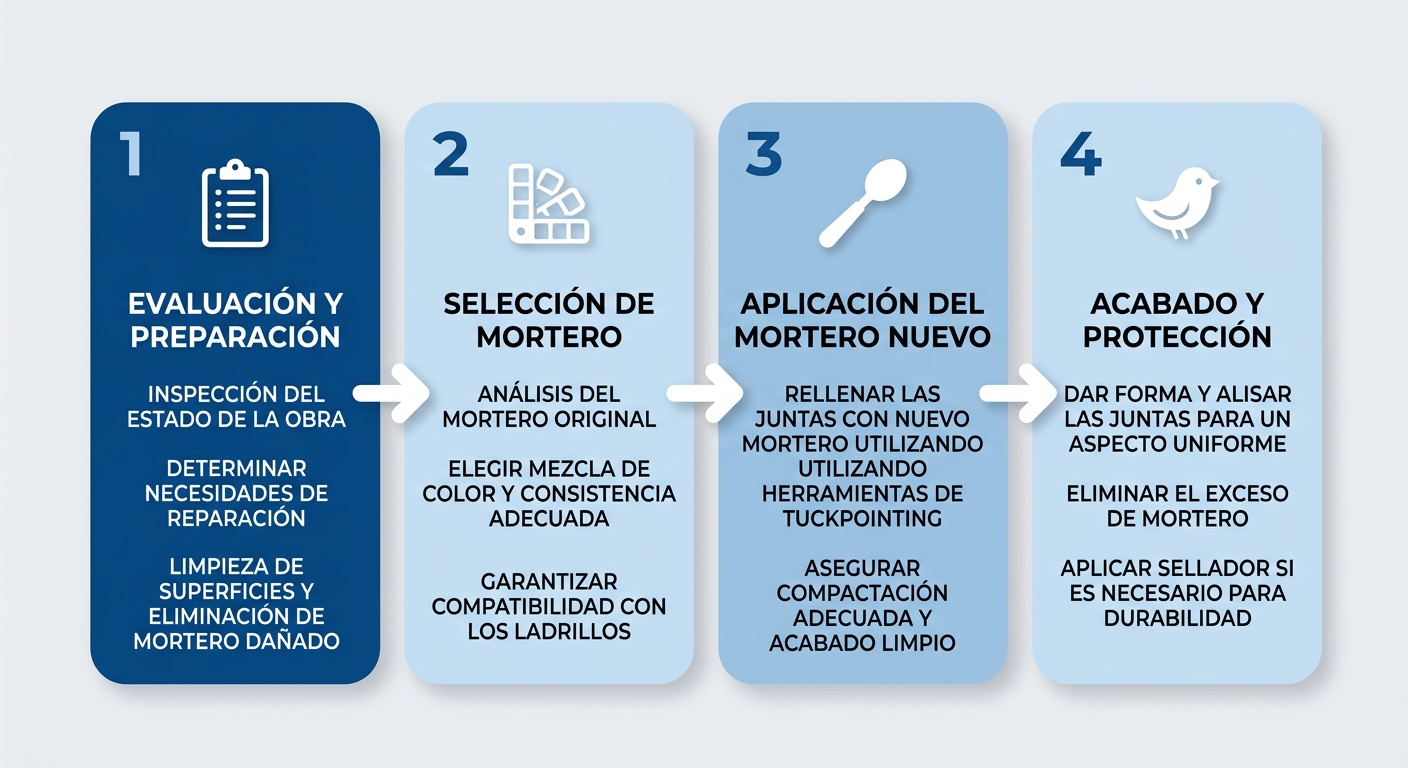
Four-step tuckpointing process from assessment to final inspection
Curing, Cleanup, and Final Inspection
After the final layer is tooled, the new mortar requires a minimum damp-curing period of 7 days under normal conditions, which we extend during extreme heat or cold to guarantee proper strength. Our team periodically mists the joints to prevent surface cracking and ensure a durable bond that withstands seasonal movement. Cleanup involves a soft brush and a non-acidic cleaning solution to gently remove any mortar residue from the brick faces, followed by a thorough water rinse that leaves your wall looking pristine. Finally, we conduct a detailed inspection — confirming the color match against the original sample, checking groove straightness, and verifying there are no voids, cracks, or structural concerns — because B&G’s mission is to provide residential and commercial customers with an outstanding level of service every time. Once the work meets our standards and yours, we provide a final walkthrough and any needed documentation. Ready to start? Get A Quote.
Best Practices for Masonry Maintenance and Inspection
Once you understand common masonry issues, adopting a proactive maintenance routine is the best way to protect your investment. If you’re looking for tuckpointing near me, understanding these best practices is essential before any repair work begins. A well-maintained brick wall can last for generations, but neglecting small problems often leads to extensive damage. We aim to enhance the appearance and improve the integrity of your house or building, and it all starts with a smart upkeep plan.
Regular Inspection: What to Look For and When
We recommend inspecting your masonry at least once a year, ideally in the spring, and always after severe weather events like heavy rain or freeze-thaw cycles. A thorough check doesn’t take long and can prevent minor issues from escalating. Keep an eye out for these key signs of distress:
- Cracks wider than 1/16 inch, which can indicate structural movement or water damage
- A white, powdery substance called efflorescence, signaling moisture is moving through the brick
- Missing or crumbling mortar in the joints, which compromises the wall’s stability
- Spalled brick faces, where the surface has flaked or broken away, often due to trapped water
- Water stains on interior walls near the masonry, a clear sign of a leak that needs immediate attention
The Brick Industry Association provides authoritative industry standards on brick construction and maintenance, emphasizing that early detection of these issues is critical. Even if no visible damage is apparent, you should hire a professional masonry contractor for an in-depth inspection every 3-5 years.
Moisture Management and Waterproofing
Water is masonry’s biggest enemy. Proper moisture management is the single most effective way to extend the life of your brickwork. The soil around your foundation should always slope away at a minimum of 6 inches over 10 feet, and downspouts need to extend at least 5 feet from the wall to direct water away. These simple landscaping practices prevent a tremendous amount of water pressure from building up against the brick.
When it comes to protecting the wall itself, choosing the right product is vital. We caution against using non-breathable sealants like latex paint or acrylic sealers, which can trap moisture inside and accelerate deterioration. Instead, we recommend breathable silane/siloxane-based waterproofers that allow water vapor to escape while blocking liquid water. For long-lasting protection, trust professional masonry waterproofing and caulking services like those offered by B&G.
When to Schedule Repairs vs Replacement
Deciding between a targeted repair and a full rebuild depends on the extent of the damage. Spot tuckpointing is an excellent solution when you have isolated mortar loss or localized damage on up to 20% of a wall section. It is a precise, cost-effective method that restores protection exactly where it is needed. Knowing the difference between repointing vs tuckpointing helps you decide the right repair method; repointing generally refers to fully replacing the outer layer of mortar, while tuckpointing involves adding a final, thin, contrasting joint line for a crisp aesthetic.
However, when more than 20% of the mortar is deteriorated, bricks have become loose, or you see deep structural cracks, a full wall repointing or a rebuild is likely necessary. Patching a failing wall piecemeal will only lead to more problems later. The brick masonry repair cost depends on the extent of damage; contact us for a custom quote. Guidelines from the International Masonry Institute support this decision-making criteria, helping professionals determine when restoration is viable and when full replacement is the safer, more durable choice.
Building Long-Term Relationships with a Masonry Partner
The best way to protect your property is to establish a long-term relationship with a trusted masonry contractor. When you partner with a team that knows the history of your building, you receive more tailored and effective care. A maintenance plan with B&G offers real, practical benefits. You’ll receive annual inspection reminders so you never miss a crucial check, priority scheduling when you need repairs quickly, and access to future repair discounts for being a loyal customer. B&G’s mission is to provide residential and commercial customers with an outstanding level of service, and that means being there for you year after year. A trusted partner like B&G can help you implement these best practices–call us today to schedule your annual inspection.
We Service Tuckpointing Clients Nationwide & Offer In-House Financing!
Securing Your Masonry’s Future with Professional Tuckpointing
Tuckpointing near me is a common search for property owners noticing crumbling mortar, but the real question is who to trust with such a critical repair. Professional tuckpointing is a preventive investment that extends the life of brick and stone structures. Ignoring worn mortar can lead to serious structural issues, water damage, and far greater expenses later on.
Understanding repointing vs tuckpointing helps explain the value: while repointing simply replaces old mortar, tuckpointing also recreates fine lines that restore both historic character and weather resistance. By catching deterioration early, you avoid the significant brick masonry repair cost tied to neglected masonry–saving money and protecting your property.
With over 20 years of masonry experience and a nationwide service reach, B&G Tuckpointing combines skill with convenience. For commercial properties, professional tuckpointing is essential for commercial masonry repair and long-term asset protection. We also offer in-house financing, making professional restoration accessible.
When you choose B&G, you benefit from:
- Extended structural life through proper mortar joint care
- Prevention of water intrusion and hidden damage
- Enhanced curb appeal with color-matched pointing
- Financing options that work with your budget
We aim to enhance the appearance and improve the integrity of your house or building. According to the International Masonry Institute, adhering to proper tuckpointing standards is critical for lasting results, a principle we follow on every project.
Take the next step to secure your masonry’s future. Contact us today to Get A Quote and start your restoration with confidence.