
Table of Contents
Understanding Foundation Brick Crumbling
Foundation brick crumbling in St. Louis refers to the gradual breakdown of brick material caused by ongoing exposure to moisture, temperature fluctuations, and dissolved salts. Over time, this brick deterioration weakens the structural core of your property, making prompt identification essential.
Moisture from rain or groundwater saturates the porous brick, initiating deterioration. As confirmed by the Brick Industry Association, water penetration is the primary cause of brick damage. In winter, freeze-thaw cycles in the St. Louis region cause trapped water to freeze and expand, cracking bricks internally. Simultaneously, groundwater salts crystallize after evaporation, generating pressure that turns solid brick into crumbling powder. While efflorescence on brick produces harmless white deposits and brick spalling is surface flaking, true crumbling reflects deep structural decay.
Early indicators of foundation brick crumbling include a fine, powdery residue on brick surfaces, loosening mortar joints, and small bits of brick detaching near the base. Cracks that radiate from foundation corners also signal advancing brick deterioration. Left unaddressed, this process can spread, leading to bowing walls and severe structural compromise.
These symptoms underscore the urgency of professional repair. Our team provides expert foundation tuckpointing services to restore damaged brickwork, stop further deterioration, and reinforce your building’s stability. We aim to enhance the appearance and improve the integrity of your house or building. Reach out to B&G Tuckpointing for a custom solution that protects your foundation for the long term.
What Causes Foundation Brick to Crumble?
Now that you know what visual signs to look for, let’s explore the specific causes behind foundation brick crumbling. In our years serving the St. Louis region, we have identified four primary culprits that contribute to most cases of brick deterioration: freeze-thaw cycling, water intrusion, mortar degradation, and chemical spalling from de-icing salts. Each of these factors attacks your foundation in a slightly different way, and recognizing the root issue is the first step toward an effective, lasting repair.
The following table provides a quick-reference comparison of these common causes.
| Cause | How It Happens | Visual Signs | Best Prevention |
|---|---|---|---|
| Freeze-Thaw Cycles | Water enters brick pores, freezes, and expands, forcing flakes off the surface. | Flaking, pitting, horizontal cracks. | Proper drainage and vapor-permeable sealers. |
| Water Intrusion & Poor Drainage | Saturated bricks soften mortar joints and accelerate salt migration. | Efflorescence (white deposits), damp patches, peeling paint. | Grading, downspout extensions, waterproof coatings. |
| Poor Mortar Mix / Age | Weak or degraded mortar cannot absorb movement, transferring stress to bricks. | Crumbling mortar, loose bricks, cracking along joints. | Professional tuckpointing with matched mortar. |
| Chemical Spalling (De-Icing Salts) | Salt crystals form inside brick pores and exert pressure that breaks the surface. | Powdery surface, shallow pitting near ground level. | Avoid salt near masonry, use calcium‑chloride alternatives. |
Each of these four causes represents a distinct challenge, but they all share a common outcome: the gradual breakdown of your foundation’s brickwork. Understanding the mechanics behind each one will help you spot the early warning signs before significant structural issues develop.
Freeze-Thaw Cycles
The most destructive force for foundation brick in cold climates is the freeze-thaw cycle. Water from rain or melting snow naturally seeps into the microscopic pores of the brick. When temperatures drop, this absorbed water freezes and expands by approximately 9%, according to technical data from the Brick Industry Association. The internal pressure created by this expansion forces thin layers or flakes off the brick surface, a specific form of brick spalling we see frequently on older homes in our region. Over time, repeated freezing and thawing can transform a smooth brick face into a pitted, crumbling surface with characteristic horizontal cracking.
Water Intrusion & Poor Drainage
Beyond seasonal freezing, simple water intrusion is a year-round threat to your foundation’s longevity. When drainage around a home is inadequate, the soil next to the foundation remains saturated. This sustained moisture softens mortar joints and initiates a destructive chemical migration. Dissolved salts from the mortar itself, or from the surrounding soil, travel with the water to the brick surface. As the water evaporates, those salts crystallize into the white, powdery deposits known as efflorescence on brick. While efflorescence itself is primarily a cosmetic issue, it signals that water is moving through the masonry. Per standards from the International Code Council, proper grading and downspout extensions are the first line of defense, as this continuous water pathway will eventually weaken the entire brick and mortar matrix.
Poor Mortar Mix / Age
Mortar plays a crucial role as the flexible cushion between rigid bricks, but its composition must be correctly matched to the brick it supports. Many historic homes were built with softer, lime-based mortars that naturally degrade over decades. However, well-intentioned repairs can cause further harm. If a modern Portland cement mortar, which is extremely hard, is applied to older, softer bricks, it creates a dangerous mismatch. The Brick Industry Association’s technical notes confirm that when the mortar is too hard, stress from normal building movement and thermal expansion is transferred directly into the brick, causing it to crack and spall. You can identify this issue by looking for crumbling mortar joints with deep erosion, loose bricks, and cracking that runs precisely along the joint lines.
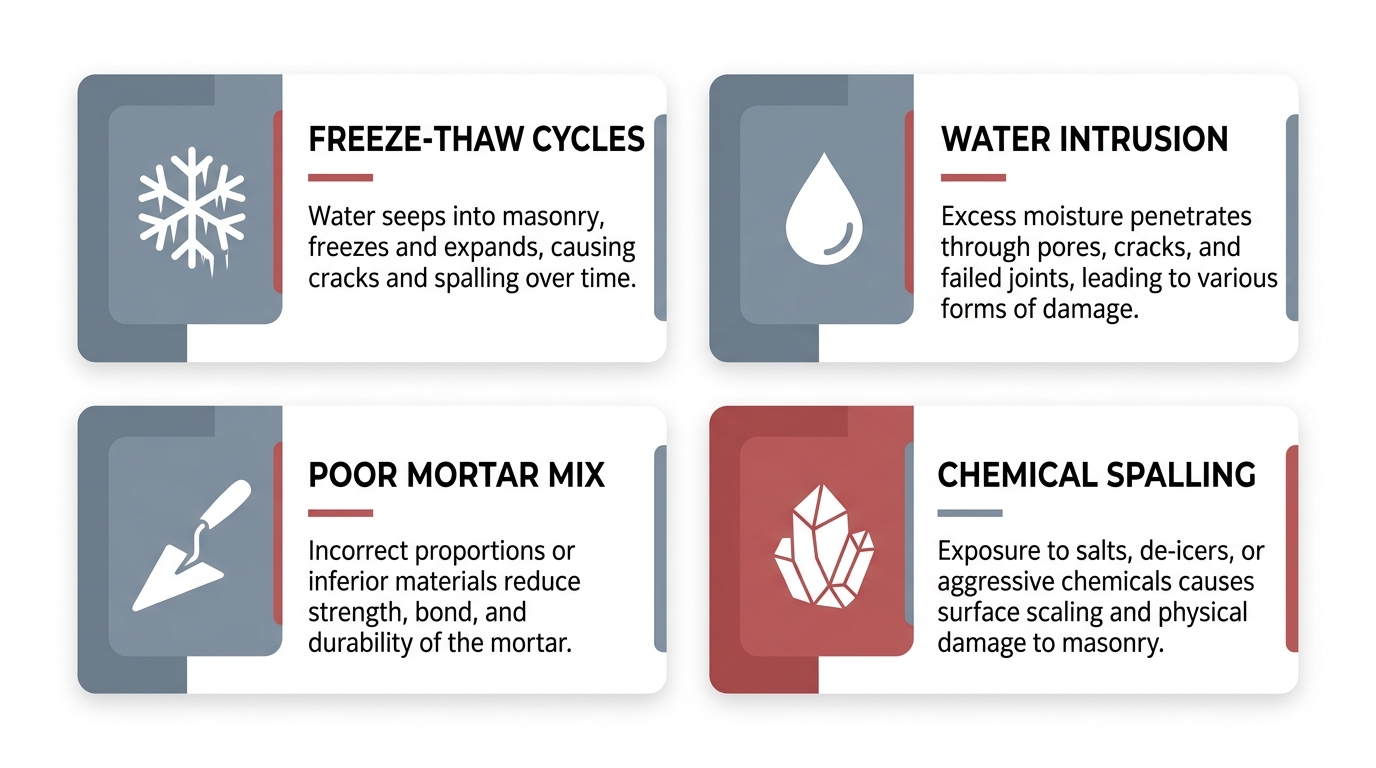
Four primary causes of crumbling foundation brickwork
Chemical Spalling (De-Icing Salts)
In regions with harsh winters, a hidden source of damage often sits right on the sidewalk. De-icing salts, primarily sodium chloride, are extremely aggressive toward masonry. When snow and ice melt on a treated walkway, the salty water splashes onto the foundation’s lower sections and soaks into the brick pores. As the moisture evaporates, salt crystals form and grow inside the microstructure of the brick. The expansive force of these growing crystals fractures the brick internally from the inside out, a process known as chemical spalling. This type of deterioration appears as a powdery, crumbling surface or shallow pitting concentrated right at the ground line. Avoiding salt-based products near brickwork offers the best protection against this entirely preventable cause.
Understanding the cause of the damage is the first step; next we look at the most effective repair methods for each issue. If your foundation brick shows signs of severe crumbling, professional foundation repair st louis services can protect your home’s structural integrity.
Identifying the Signs of Brick Deterioration
To keep your brickwork in top shape, it helps to recognize the first warning signs of deterioration. Many homeowners first become concerned when they notice their foundation brick crumbling, but by the time damage of that magnitude becomes visible, the underlying issues have often been at work for years. Understanding the differences between common brick problems empowers you to act before a cosmetic blemish turns into an expensive structural repair.
Brick spalling appears as flaking, pitting, or peeling of the brick surface and is one of the most direct signs that moisture is actively damaging your masonry. According to the Brick Industry Association, the freeze-thaw cycles common in cold climates like St. Louis, MO accelerate this process dramatically. When water penetrates the brick face and freezes, it expands, forcing the surface to detach from the body of the brick. Over time, what begins as shallow surface pitting can progress until the brick loses enough material to compromise the wall’s load-bearing capacity.
Efflorescence on brick, by contrast, presents as a white powdery deposit that often alarms property owners who mistake it for permanent staining. The International Code Council’s masonry standards recognize that these water-soluble salts migrate to the surface when moisture moves through the brick, leaving the crystalline residue behind as the water evaporates. On its own, efflorescence is a cosmetic issue and carries a low structural risk. However, the moisture that carries the salts is the real concern–if left unaddressed, that persistent dampness creates the conditions in which brick spalling eventually takes hold. Brushing away the salt deposits provides only temporary relief; a lasting solution requires identifying and stopping the water source feeding the wall.
Structural cracking demands the most immediate attention of the three conditions. Vertical, diagonal, or step cracks that travel through brick and mortar joints indicate that forces beyond normal wear are acting on your building. The International Code Council’s construction standards identify settlement, foundation movement, and lateral pressure as the primary causes of such cracking, and the structural risk is high as soon as these cracks appear. Unlike spalling or efflorescence, structural cracking cannot be resolved with surface repairs. Our team at B&G Tuckpointing frequently sees this pattern in older St. Louis brickwork, where decades of ground movement and moisture fluctuation have gradually shifted the foundation.
When you notice cracked masonry or signs that your brick is actively deteriorating, professional evaluation becomes essential. We serve tuckpointing clients nationwide and offer in-house financing, so whether you need a facelift for a single residential wall or comprehensive commercial building restoration, you can get started without a large upfront payment. If any of the conditions described here–especially foundation brick crumbling–appear on your property in St. Louis, MO or anywhere across the country, contact B&G today for masonry repair near me. We aim to enhance the appearance and improve the integrity of your house or building with a solution tailored to the exact condition of your brickwork.
Preventive care can greatly reduce the chance that minor moisture problems evolve into major repairs. Keeping gutters clear, directing downspouts well away from foundation walls, and applying breathable sealants where appropriate all work to control the water exposure that drives both efflorescence on brick and spalling. Routine visual inspections–especially after winter freeze-thaw cycles–allow you to catch early flaking or salt deposits before they advance. Once you have identified what is wrong, it is time to choose the right repair approach.
Repairing Crumbling Bricks in Your Foundation
When you notice your foundation bricks are cracking, flaking, or turning powdery, it’s natural to feel a sense of urgency. This condition, commonly referred to as foundation brick crumbling, compromises both the look and the structural backbone of your home or commercial building. Before you can choose the right fix, it’s essential to understand what’s actually happening to the masonry. Catching these problems early prevents a small repair from turning into a massive structural issue.
Understanding Tuckpointing: Repairing the Joints
When the mortar between your bricks has deteriorated but the bricks themselves are still sound, the right solution is often tuckpointing. This involves carefully grinding out the old, crumbling mortar to a uniform depth and then repacking the joints with a fresh mix that’s been color-matched to your existing mortar. According to the Brick Industry Association, using a compatible mortar mix is critical for maintaining structural integrity and preventing further damage.
We perform tuckpointing on both a spot basis for isolated areas and as a solid repointing of an entire wall. A benefit of this approach is that it restores the wall’s original moisture barrier without replacing any brickwork unnecessarily. For many of our residential and commercial clients, this is the most cost-effective way to extend the life of a foundation.
When to Choose Spot Brick Replacement
If the damage goes deeper than the mortar and has actually caused individual bricks to spall or crack, a more targeted repair is necessary. Brick spalling often causes crumbling by allowing water to penetrate the face of the brick, which then expands and breaks apart during freeze-thaw cycles. In these cases, tuckpointing alone won’t solve the problem because the brick unit itself is compromised.
Our masons address this by carefully cutting out the damaged bricks without disturbing the surrounding wall. We then source salvaged or specially manufactured replacements that match the original brick in size, color, and texture. A spot brick replacement is best when only a few bricks are failing and the rest of the foundation is in good shape, making it a moderate but highly localized investment.
Partial Foundation Rebuild: The Permanent Solution
Sometimes the damage is too widespread for individual brick fixes. Extensive spalling, deep cracking, or a section of wall that’s beginning to bow outward signals a more serious problem requiring a partial foundation rebuild. In this procedure, we remove and painstakingly reconstruct the damaged section of the foundation wall using new brick and mortar, tying it back into the existing stable structure.
For a permanent solution to extensive crumbling, consider our professional brick rebuild services. This kind of restoration is a larger investment, but when done by an experienced crew, the rebuilt section will perform as well as the original construction and can last for 50 years or more. It’s the definitive answer when your foundation needs more than just a surface repair.
Choosing the Right Repair Method
The following table compares the most common approaches we use, so you can see at a glance which might be the right fit for your foundation.
| Issue | Appearance | Primary Cause | Structural Risk | Required Repair |
|---|---|---|---|---|
| Brick Spalling | Flaking, pitting, or peeling of the brick surface. | Freeze-thaw cycles, salt crystallization. | Moderate if only surface; high if deep spalling extends through the brick. | Tuckpointing, spot brick replacement, sealant application. |
| Efflorescence | White, powdery salt deposits on brick surface. | Water-soluble salts migrating to the surface. | Low – cosmetic unless accompanied by spalling or cracking. | Brush off, address moisture source, consider water repellent. |
| Structural Cracking | Vertical, diagonal, or step cracks in brick or mortar joints. | Settlement, foundation movement, lateral pressure. | High – immediate assessment recommended. | Foundation stabilization, brick rebuilding, possible underpinning. |
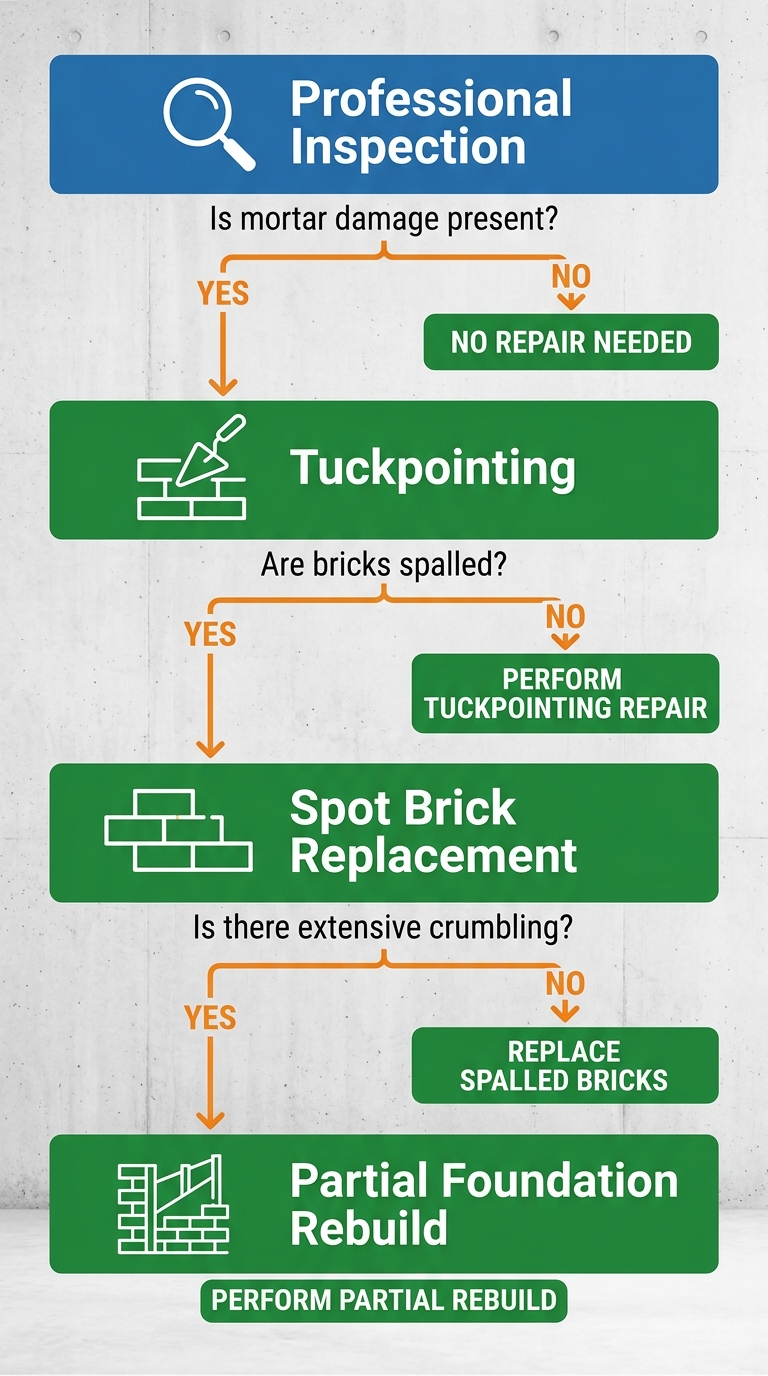
Decision tree for crumbling foundation brick repair
The decision tree above walks you through the logical path we take during an evaluation, starting with a thorough inspection. By understanding the severity of the damage, we can confidently recommend whether tuckpointing, a brick swap, or a small rebuild will deliver the lasting results you need.
Once you choose the right repair approach, the next step is getting a custom quote tailored to your specific project. We Service Tuckpointing Clients Nationwide & Offer In-House Financing! We’ve invested over two decades in perfecting our masonry restoration techniques, and we aim to enhance the appearance and improve the integrity of your house or building. Whether you need a minor repointing job or a major rebuild, our team is ready to help you protect your foundation for years to come.
Get A Quote
Long-Term Strategies for Foundation Brick Preservation
Once urgent issues like foundation brick crumbling, brick spalling, and efflorescence on brick have been professionally repaired, implementing a long-term preservation strategy ensures your foundation stays strong for decades. In our years of serving St. Louis homeowners, we’ve seen how routine care prevents small problems from becoming major structural concerns.
For most freeze-thaw climates like here in St. Louis, a silane/siloxane sealer offers the best balance of durability and breathability. However, before applying any product, you must remove existing efflorescence with a mild acid wash or stiff brush–trapping those white deposits beneath a sealer only accelerates brick decay. After cleaning, follow the manufacturer’s recommended schedule for reapplication, knowing that UV exposure and rain intensity in your region will affect actual longevity.
Beyond sealants, we recommend a yearly visual inspection of your foundation brick each spring and fall. Look for new cracks, loose mortar joints, or returning efflorescence that may signal moisture issues behind the surface. Maintain proper grading around your home and extend downspouts to direct water at least four to six feet away from the foundation–small adjustments here dramatically reduce hydrostatic pressure against your brickwork. Installing foundation vents or a basement dehumidifier also helps control interior moisture that can migrate through masonry from the inside out. Keep a simple maintenance log noting sealer application dates and inspection findings to track your home’s condition over time.
If you notice serious structural issues despite regular sealing, it’s time to schedule brick repair st louis with trusted masons. By following these strategies and combining DIY diligence with professional tuckpointing, you can protect your foundation for years to come. For a custom preservation plan, contact B&G Tuckpointing for a quote.
Questions About Foundation Brick Crumbling
Now that you know what causes brick damage, you may have questions about foundation brick crumbling.
Q: What causes foundation brick crumbling? Foundation brick crumbling is often caused by moisture infiltration, freeze-thaw cycles, and poor drainage. Repeated water exposure weakens mortar joints and leads to brick spalling.
Q: Is crumbling brick a sign of structural damage? While crumbling brick can signal deeper problems, tuckpointing or brick replacement often fixes it early, especially if you address efflorescence on brick.
Q: Can crumbling foundation bricks be repaired? Yes, B&G Tuckpointing offers spot tuckpointing, color matching, and brick replacement in your area–all backed by 20 years of masonry experience for a durable, color-matched result.
Q: How soon should crumbling foundation brick be addressed? Prompt repair prevents escalating costs and structural damage. For expert tuckpointing, visit our brick repair near me page to get a quote. We offer in-house financing and nationwide service.
Preserving Your Foundation with Professional Masonry Care
Foundation brick crumbling signals a serious threat to your home’s stability and curb appeal. Left unaddressed, moisture seeps into hairline cracks, freezes, and forces the brick face to flake away — a process called brick spalling. White, powdery efflorescence on brick often appears alongside it, revealing trapped water within the masonry. Professional tuckpointing removes deteriorated mortar, repoints the joints with fresh material, and restores structural integrity before small cracks become major foundation repair projects. We blend 20 years of experience with color-matched techniques so the fix stays virtually invisible. Contact B&G for a free quote and protect your home’s foundation.