
Table of Contents
Water Damage on Brick Walls: Signs, Causes, and Solutions
Beyond general wear and tear, one of the most pressing issues we see is water damage brick wall deterioration. Understanding its signs and solutions can save costly repairs. Our team, guided by the mission to provide residential and commercial customers with an outstanding level of service, helps you interpret symptoms and restore brickwork.
According to the Brick Industry Association, common signs include:
- White, powdery efflorescence on brick walls, especially after rain
- Spalling, where brick faces flake off due to internal pressure
- Horizontal or stair-step cracks in mortar joints
- Dark, damp patches or mold growth on interior or exterior walls
As the Brick Industry Association notes, freeze-thaw cycles drive water damage: water seeps into porous brick, deteriorated mortar, or failed flashings, then freezes and expands, forcing brick faces off. Clogged gutters, poor site drainage, missing caulking around windows and doors, and non-breathable coatings further trap moisture.
According to the Association for Preservation Technology International, repointing (tuckpointing) of deteriorated mortar is the gold standard for repairing water-damaged brick. Hiring a professional tuckpointing contractor ensures color-matched mortar and proper joint preparation. Additional solutions include waterproofing with a vapor-permeable sealant and spot tuckpointing for localized spalling brick repair, all of which reduce future water damage brick wall risks.
For a custom quote, Get A Quote today–we serve homeowners nationwide and offer in-house financing.
How Water Damages Brickwork: The Basics
Water damage brick wall surfaces can turn a small irritation into a major structural headache. Water is brick masonry’s biggest enemy, creeping through pores and cracks to cause efflorescence, spalling, and mortar failure. Spotting the signs early can save you from costly repairs.
To help you identify what’s happening, we’ve compiled the most common water damage brick wall issues in the table below. Knowing the difference between a white stain and a crumbling brick face guides your next steps.
| Deterioration Type | Primary Cause | Visible Signs | Urgency | Repair Approach |
|---|---|---|---|---|
| Efflorescence | Water dissolving soluble salts, then depositing them on the brick surface as the water evaporates | White, powdery or fluffy deposits on the brick face | Low to moderate (cosmetic concern that can signal ongoing moisture) | Clean with water, dry brush, or mild acidic cleaner; address the moisture source |
| Spalling | Freeze-thaw cycles — water enters the brick, freezes, expands, and forces the brick face to flake off | Flaking, chipping, or crumbling brick surface; delamination of the brick face | High (structural integrity is compromised) | Remove and replace affected bricks; apply waterproofing if needed |
| Mortar Deterioration | Erosion of mortar joints from water penetration, freeze-thaw, or aging | Cracked, crumbling, or missing mortar between bricks; loose bricks | High (loss of lateral support, water intrusion into wall cavity) | Tuckpointing — remove old mortar and repoint with fresh, color-matched mortar |
These three problems may look similar at first, but they each demand a different response. Efflorescence–those chalky white deposits–is mainly a cosmetic issue, though it indicates moisture is moving through your wall. According to the International Masonry Institute, efflorescence on brick should prompt you to find and fix the water source. Spalling, the flaking and crumbling of brick surfaces caused by freeze-thaw cycles, is far more urgent. The Brick Industry Association stresses that professional spalling brick repair is critical once the brick face begins to delaminate. Mortar deterioration, where joints erode and bricks loosen, often requires thorough tuckpointing to restore stability. For lasting results, we recommend solid tuckpointing to seal out moisture and reinforce the wall.
Here’s a quick comparison:
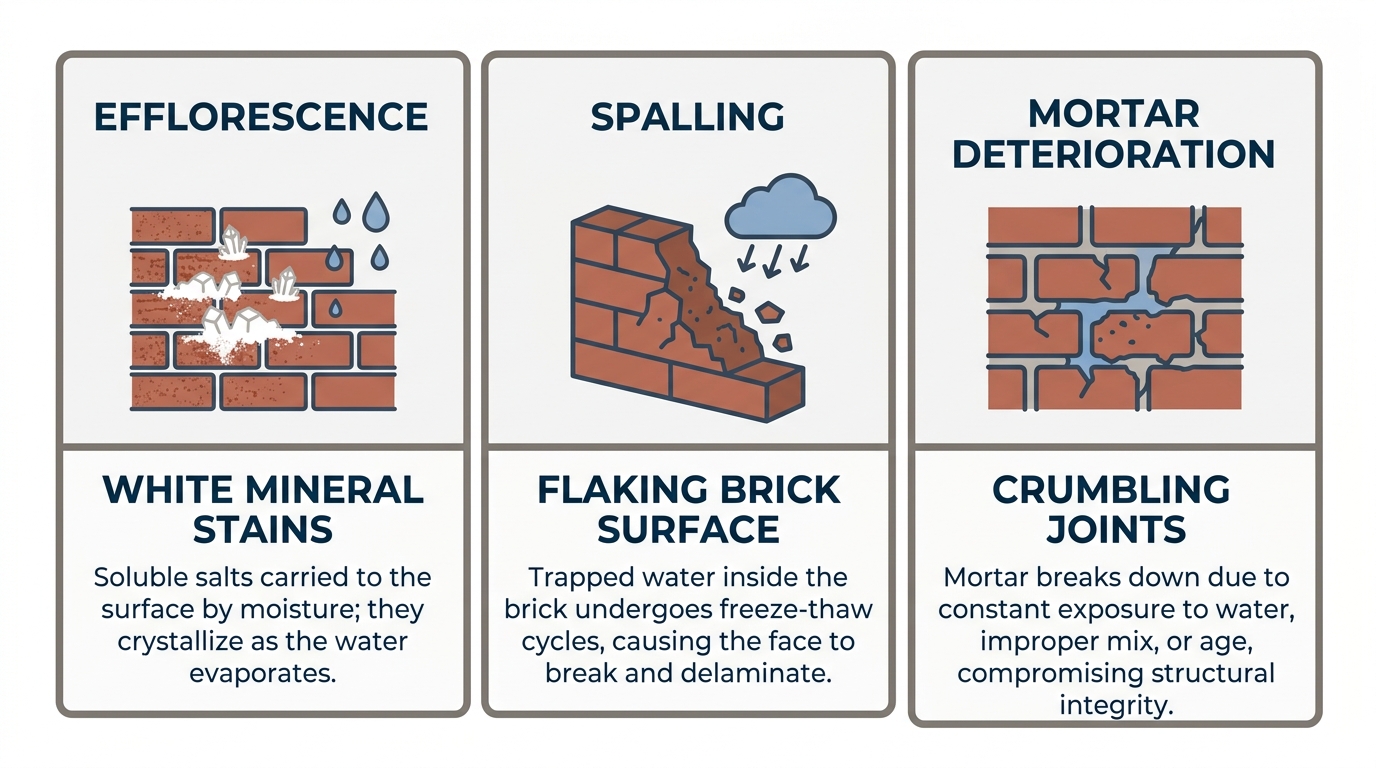
Compare brick damage types: efflorescence, spalling, mortar decay.
If you spot any of these problems, especially spalling or failing mortar, reach out to B&G Tuckpointing. We’ll evaluate your brickwork and recommend a repair plan. Request a personalized quote today to protect your investment.
The Hidden Impact of Water on Brick Structural Integrity
While visible signs of moisture are troubling, the hidden impact of water on brick integrity is often more severe–and harder to detect. Chronically damp brickwork slowly undermines the wall’s compressive strength, speeding up deterioration well before obvious cracks appear. A water-damaged brick wall can appear sound on the surface while progressive decay advances within the masonry assembly. We understand how moisture penetrates and weakens even well-built brick structures.
The Freeze-Thaw Cycle and Its Effect on Masonry
The relentless freeze-thaw cycle is one of the most destructive forces affecting brick masonry. Water enters microscopic pores and hairline cracks in brick faces, and when temperatures drop, that trapped moisture freezes and expands by roughly nine percent. This internal pressure fractures the brick’s internal structure, leading to spalling–the flaking or peeling of brick surfaces–and a measurable reduction in compressive strength. According to technical guidance from the Brick Industry Association’s (goBrick) Technical Note 28, water penetration through brick veneer is commonly accelerated by flashing failure, weep hole blockage, and porous mortar joints. As cycles repeat over multiple winters, the cumulative effect progressively weakens the entire wall assembly.
Early signs often appear as efflorescence on brick surfaces–those white, powdery salt deposits that signal persistent moisture migration. While efflorescence stains on brick surfaces may seem cosmetic, they indicate that enough water is moving through the masonry to dissolve salts within the brick, mortar, or soil. In regions prone to frequent freeze-thaw events, even low-level chronic dampness can escalate into structural concerns within one to three years. Regular inspection helps property owners catch these issues before costly repairs become necessary.
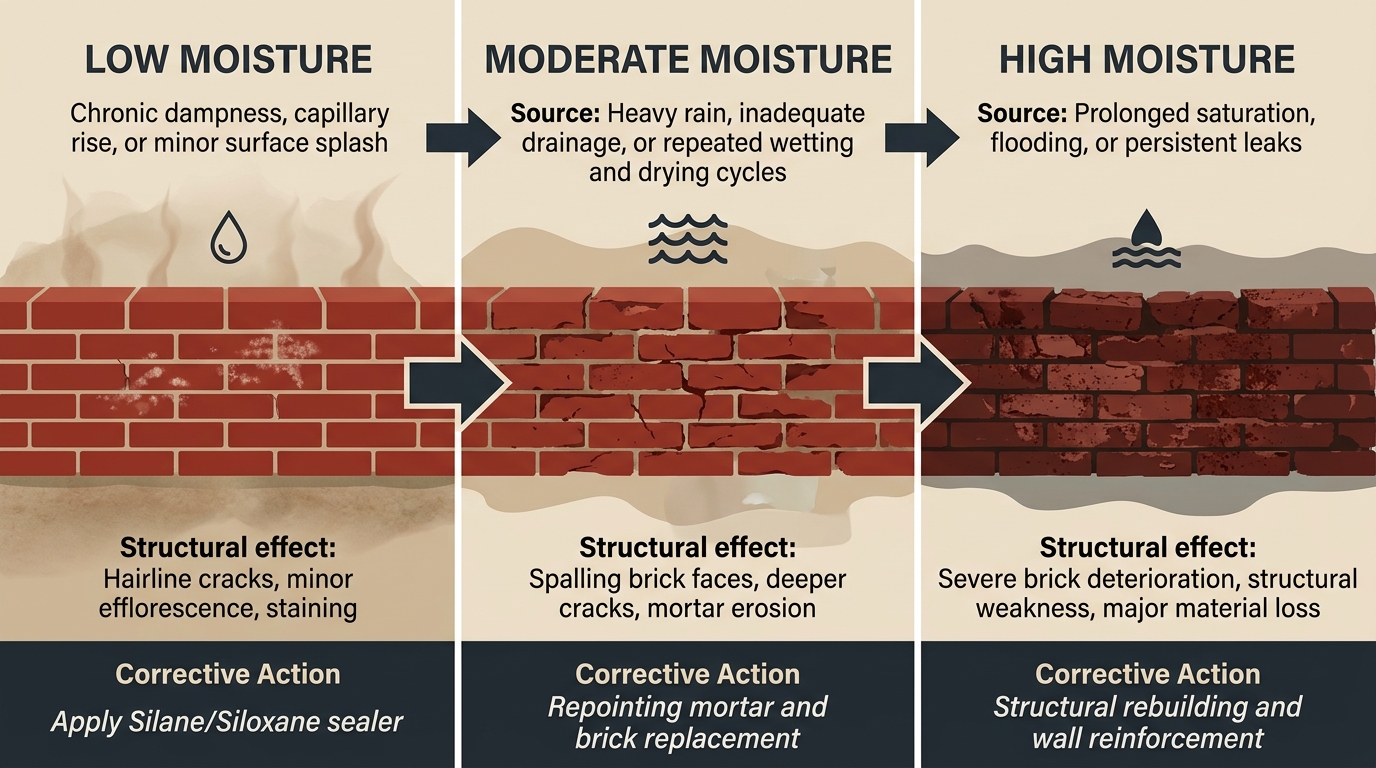
Three levels of moisture impact on brick and corrective actions
Mortar Joint Failure and Water Intrusion Pathways
Water doesn’t just attack the bricks themselves–mortar joints often fail first, creating direct pathways for deeper moisture intrusion. Many older buildings still feature softer, lime-based mortar that is more water-absorbent than the surrounding brick, meaning the joints deteriorate faster under repeated wetting and drying. The Association for Preservation Technology (APT) Preservation Brief 1 cautions against sealing mortar without proper diagnostics, as inappropriate waterproofing can trap moisture inside the wall and accelerate deterioration from within.
As mortar joints soften and erode, gaps form and widen, allowing rainwater, groundwater, and condensation to bypass the exterior brick layer and reach the structural backup. Clogged weep holes and faulty flashing compound the problem by preventing water from draining back to the exterior. B&G’s mission is to provide residential and commercial customers with an outstanding level of service, and that starts with helping property owners understand that mortar joint health is critical to long-term water management. When joints fail, water travels laterally within the wall cavity, reaching areas far from the original entry point and causing damage that remains invisible until significant decay has occurred.
Long-Term Structural Risks of Unaddressed Moisture
When moisture problems go unaddressed, the progression from minor deterioration to serious structural compromise is almost inevitable. Prolonged saturation–whether from failed through-wall flashing, plumbing leaks, or continuous groundwater intrusion–causes widespread spalling, mortar washout, and brick delamination as the masonry bond degrades layer by layer. Over 10 to 20 years, accelerated by freeze-thaw cycling, walls may begin to bow or bulge outward as the assembly loses its load-bearing capacity.
The following table illustrates how moisture severity correlates with structural impact and the corrective actions required.
| Deterioration Type | Primary Cause | Visible Signs | Urgency | Repair Approach |
|---|---|---|---|---|
| Efflorescence | Water dissolving soluble salts, then depositing them on the brick surface as the water evaporates | White, powdery or fluffy deposits on the brick face | Low to moderate (cosmetic concern that can signal ongoing moisture) | Clean with water, dry brush, or mild acidic cleaner; address the moisture source |
| Spalling | Freeze-thaw cycles — water enters the brick, freezes, expands, and forces the brick face to flake off | Flaking, chipping, or crumbling brick surface; delamination of the brick face | High (structural integrity is compromised) | Remove and replace affected bricks; apply waterproofing if needed |
| Mortar Deterioration | Erosion of mortar joints from water penetration, freeze-thaw, or aging | Cracked, crumbling, or missing mortar between bricks; loose bricks | High (loss of lateral support, water intrusion into wall cavity) | Tuckpointing — remove old mortar and repoint with fresh, color-matched mortar |
As moisture levels increase, structural damage accelerates and requires progressively more extensive repairs. For moderate moisture damage, corrective actions include spot tuckpointing and replacing spalled bricks–we offer both across the country. When saturation reaches higher levels, spalling brick repair becomes part of a broader restoration scope that may require rebuilding entire wall sections, addressing foundation movement, and installing comprehensive waterproofing systems. We Service Tuckpointing Clients Nationwide & Offer In-House Financing!
Ignoring low-level moisture for even one to three years can lead to moderate damage requiring spot repairs, and high saturation left unchecked for a decade or more often demands full masonry restoration and foundation repair. We aim to enhance the appearance and improve the integrity of your house or building with color-matched solutions that preserve the character of both historic and modern brickwork. Understanding these risks makes it clear that addressing moisture early can save thousands in future repairs–and that’s where we come in. Get A Quote today to schedule an assessment and protect your property from hidden water damage.
Diagnosing and Addressing Water Damage on Your Property
If you notice water damage on brick walls, taking early action can prevent costly repairs. Let’s walk through spotting the damage, choosing the right fix, and working with a pro.
A Homeowner’s Guide to Inspecting Brick Walls
Look for three telltale signs. efflorescence on brick is a white, powdery residue–harmless salt but a moisture marker. Spalling (flaking brick faces) means water is trapped inside the clay. Cracked or missing mortar lets water deeper.
Test a few joints with a flathead screwdriver. If mortar crumbles easily or the tip sinks past 1/2 inch, professional repair is needed. The International Masonry Institute confirms sound mortar should hold firm.
Light efflorescence often scrubs off with water; stubborn deposits use a 1:4 vinegar-water rinse. If white powder reappears or spalling is present, the moisture source must be fixed–affected bricks need replacement.
Any mortar crack wider than 1/8 inch or active water entry demands tuckpointing. When over 20% of joints are deteriorated, full repointing outperforms spot repairs.
Matching the Repair Method to the Damage Type
Tuckpointing remedies cracked or missing mortar. Joints wider than 1/8 inch that let water through must be raked and repacked with color-matched, breathable mortar. If over 20% of joints are failing, full repointing restores drainage better than spot fixes.
Spalling brick repair means removing the damaged brick and installing a match. DIY removal risks chipping adjacent brick and leaves visible color differences; professional replacement ensures seamless blending.
For waterproofing, the Brick Industry Association’s Technical Note 7B warns that film-forming sealers can trap moisture in soft brick, worsening freeze-thaw damage. Choose a penetrating repellent that lets vapor escape. For St. Louis properties, our team can assess the brick and recommend a compatible product. Expert spalling brick repair in St. Louis ensures the replacement bricks blend seamlessly and weather consistently.
The table below breaks down what you can safely handle and when it’s time to bring in a pro.
| Moisture Level | Typical Sources | Structural Effects | Time to Noticeable Damage | Common Corrective Action |
|---|---|---|---|---|
| Low (chronic dampness) | Rain splash-back, leaking gutters, rising damp from soil | Efflorescence, slight mortar softening, cosmetic staining | 1-3 years | Improve drainage, seal cracks, apply breathable waterproofing |
| Moderate (repeated wetting/drying) | Faulty flashing, clogged weep holes, poorly sealed windows/doors | Spalling on brick faces, mortar joint cracking, minor brick displacement | 5-10 years | Spot tuckpointing, replace spalled bricks, install flashing/weep holes |
| High (prolonged saturation) | Failed through-wall flashing, plumbing leaks, continuous groundwater intrusion | Widespread spalling, mortar washout, brick delamination, wall bowing or bulging | 10-20 years (accelerated with freeze-thaw) | Major masonry restoration — solid tuckpointing, brick replacement, foundation repair, comprehensive waterproofing |
As you can see, while light efflorescence removal is manageable at home, tasks like mortar repair and waterproofing require the precision and tools only a trained contractor can deliver.
Working with a Masonry Professional for Lasting Results
When water damage is extensive, a pro is the smartest choice. DIY brick replacement can chip surrounding units and void warranties. A search for “masonry repair near me” quickly connects you with experienced professionals. At B&G Tuckpointing, our mission is to provide residential and commercial customers with an outstanding level of service. With over 20 years of experience, we offer free estimates–on-site or photo-based–and we Service Tuckpointing Clients Nationwide & Offer In-House Financing!
Our restoration process uses moisture detection tools and precise color-matching to develop a plan with breathable sealers. Once the repair path is chosen, you can restore your brickwork’s strength and beauty. Get A Quote at bgtuckpointing.com or call us for a no-obligation evaluation.
Preventive Masonry Maintenance and Long-Term Protection
Water damage to a brick wall can cause efflorescence on brick–unsightly white stains–and eventually necessitate spalling brick repair when freeze-thaw cycles flake the surface. Preventive masonry maintenance is far more cost-effective than major repairs, preserving both appearance and structural integrity. According to the Association for Preservation Technology International (APT), abrasive cleaning methods like sandblasting can damage the brick’s fire-skin and increase moisture vulnerability. We always recommend gentle, non-abrasive techniques to protect your masonry.
To combat moisture proactively, selecting the right waterproofing method is crucial. The table below compares three proven strategies:
| Aspect | DIY Approach | Professional Service |
|---|---|---|
| Inspection | Visual check for efflorescence, spalling, mortar cracks; use a screwdriver to probe mortar | Comprehensive assessment including moisture meters, borescope inspection, structural evaluation |
| Efflorescence Removal | Water and stiff brush; for stubborn deposits, a diluted white vinegar solution | Industrial-grade cleaners and pressure washing with controlled runoff; may include sealant recommendation |
| Mortar Repair | Not recommended — improper mortar mix or depth can worsen damage | Precision tuckpointing with color-matched, breathable mortar; ensures full joint depth and drainage |
| Brick Replacement | Extremely difficult without experience; risk of damaging surrounding bricks | Expert removal and replacement of spalled or deteriorated bricks, matched to existing texture and color |
| Waterproofing | Over-the-counter sealers; risk of trapping moisture if applied incorrectly | Advice on appropriate products (penetrating vs. film-forming) based on brick type and exposure; professional application |
Breathable siloxane/silane sealers are best for historic brick because they repel water while letting vapor escape, preventing interior moisture buildup. Film-forming acrylic coatings provide a flexible barrier but should only be applied to brick that doesn’t need to breathe; otherwise they can trap water and accelerate spalling. The combination of professional tuckpointing and a topical water repellent offers the longest-lasting protection, as the International Masonry Institute recommends addressing deteriorating mortar joints before any coating is applied.
With 20 years of masonry experience, we know that preventive care protects your investment. B&G’s mission is to provide residential and commercial customers with an outstanding level of service, and we aim to enhance the appearance and improve the integrity of your house or building. If moisture issues are a concern, our team can assess your masonry and recommend the ideal solution. For St. Louis area homeowners, comprehensive brick restoration st louis safeguards your property for decades. We Service Tuckpointing Clients Nationwide & Offer In-House Financing! Contact us to Get a Quote.
Common Questions About Brick Water Damage Answered
Now that you know what to look for, let’s answer the most common questions homeowners ask about water damage on brick walls. We Service Tuckpointing Clients Nationwide.
- What does water damage on brick walls look like? Water damage on brick walls often appears as white chalky deposits–efflorescence–or as flaking surfaces called spalling. Both signal moisture intrusion that requires attention.
- What causes white powder on brick? According to the International Masonry Institute, that white powder is efflorescence on brick–salt deposits left behind as moisture evaporates from the wall.
- Can spalling brick be repaired? Yes, spalling brick repair restores damaged brickwork through replacement or tuckpointing. Our nationwide team assesses the extent and provides custom solutions.
- Should I seal my brick to prevent water damage? Breathable sealers can reduce brick water penetration, but the Brick Industry Association warns that incorrect application traps moisture inside walls.
If you spot water damage on your brick, reach out for a free quote–our mission is to provide an outstanding level of service.
Preserving Your Brick Investment for Years to Come
Beyond repairs, preserving your brick investment starts with caulking–your #1 defense against water damage brick wall problems. Prompt tuckpointing seals moisture entry points to stop efflorescence on brick from returning. Consistent sealing and waterproofing make spalling brick repair unnecessary. The BIA recommends inspections every 3-5 years. The IMI stresses that only professional caulking prevents moisture trapping. With 20 years of expertise, we offer reliable caulking services near me and waterproofing to protect your brick nationwide. To learn how our preventive services can protect your walls, Get A Quote today.