
Table of Contents
Why Brick Mortar Falls Out and Why It Matters
Have you noticed brick mortar falling out of your walls or found sandy debris along your foundation? It’s a common issue that signals something deeper is happening within your masonry. We want to help you understand what’s going on so you can make the best decisions for your property.
The most frequent culprit in our climate is the freeze-thaw cycle. Water seeps into tiny pores in the mortar, and when it freezes, it expands. This expansion creates internal pressure that causes the mortar to crack and weaken, eventually leading to crumbling mortar between bricks when the bond breaks down. We see this cycle repeat year after year across the St. Louis area, gradually turning solid joints into loose, sandy material.
Sometimes the problem isn’t just the weather — it’s the mortar itself. Many older structures were built with mortar mixes that were poorly proportioned, making them either too hard or too soft relative to the surrounding brick. According to technical standards published by the Brick Industry Association, a mismatched mortar can deteriorate long before the brick does, accelerating joint failure. Add in subtle foundation settlement or vibration from nearby traffic, and the mortar joints can separate much sooner than expected.
The bigger concern is what happens when we leave these gaps untreated. Missing mortar creates a direct path for moisture to travel behind the brick and into your wall system. Over time, this trapped water can damage interior walls, promote mold growth, and compromise the stability of the entire wall. That’s why professional mortar joint repair is essential to protect your investment and keep your building watertight. Addressing crumbling mortar early on prevents a chain of costly repairs down the line and keeps your home or building standing strong.
The good news is that these problems can be fixed with professional tuckpointing — and that’s exactly what we’ll cover next.
Understanding the Causes of Crumbling Mortar
Crumbling mortar between bricks is a common issue that property owners encounter, but the origins of this problem are often more complex than simple age. When we talk about mortar failure, we’re looking at a breakdown of the binding material that holds masonry units together, which can be influenced by a variety of environmental and structural factors. At B&G Tuckpointing, we’ve spent over a decade analyzing these failures to provide targeted, lasting solutions for our clients.
The most frequent culprits behind deteriorating mortar are moisture penetration and seasonal freeze-thaw cycles. Water has a unique ability to find its way into the smallest cracks in a brick wall. When temperatures drop, that trapped moisture freezes and expands, generating internal pressures that the mortar was never designed to withstand. This cycle can repeat dozens of times over a winter, gradually causing the mortar to crack and crumble away from the joints. Even in warmer climates, persistent moisture from humidity or rain can still erode the natural binders in the mortar over time, weakening its bond without the need for ice.
Beyond weather, the composition of the mortar itself plays a critical role in its longevity. Older buildings were often constructed with lime-based mortars that are softer and more breathable than the bricks themselves, a deliberate design choice that allowed the mortar to sacrifice itself rather than damaging the masonry units. However, if that original mortar was improperly mixed, or if it was later repaired with an incompatible modern, high-Portland cement mortar, accelerated deterioration is common. A hard, inflexible mortar patch on a soft, historic brick can trap moisture and create a rigid bond that cracks the brick as the wall naturally shifts. These fundamental material incompatibilities require professional restoration techniques, such as spot tuckpointing, to carefully remove the failing material and replace it with a historically and structurally appropriate match.
Structural movement is another major factor that is frequently overlooked. A building’s foundation will settle over time, and this gradual shift places stress on the rigid masonry walls above. Even slight ground movement can create hairline cracks in the mortar joints, which then become entry points for the moisture issues we discussed earlier. Furthermore, vibrations from nearby traffic, heavy construction, or seismic activity can all contribute to the mortar losing its grip on the brickwork. It is the combination of these subtle, sustained pressures and environmental exposure that typically brings mortar to its breaking point.
Understanding these root causes–from water intrusion and material mismatch to structural stress–is the first step toward a durable repair. A quick visual patch won’t solve a water-management problem, just as it won’t stop a settling foundation. This is why we focus on a holistic assessment of every project, ensuring that the underlying issue is resolved before the restoration begins.
From Failing Joints to Structural Risks: How Mortar Failure Compromises Your Home
When you notice brick mortar falling out of your wall, it is more than a cosmetic issue–it is an urgent warning sign that your home’s structural envelope has been compromised. At B&G Tuckpointing, we understand that neglecting these seemingly small problems today can evolve into major structural hazards tomorrow. Our two decades of hands-on masonry experience have taught us that every crack has a story, and that story almost always ends with water where it does not belong.
The Progression from Hairline Cracks to Full Joint Loss
The journey from a solid brick wall to a structurally questionable one begins deceptively. It often starts with hairline cracks–fissures so narrow they go unnoticed by the untrained eye. These micro-fractures are typically the result of natural building settlement, thermal expansion, and years of exposure to the elements. While they may appear harmless at first glance, according to the Brick Industry Association, even the smallest break in a mortar joint can initiate a slow cascade of deterioration.
Once those initial cracks form, the freeze-thaw cycle takes over. Moisture penetrates the tiny openings, and when temperatures drop, it expands as ice, acting like a wedge that widens the cracks with every season. What was once a hairline fracture gradually becomes a deep crevice. Without professional intervention, the mortar begins to disintegrate, leaving you with crumbling mortar between bricks. In advanced stages, we often see full joint loss, where the mortar is missing entirely, exposing the raw edges of the brick directly to wind, rain, and ice. At this point, the wall loses its cohesive strength, and sections of masonry can begin to shift or bulge outward.
The Water Damage Connection
The most destructive consequence of failing mortar is not the visible gap itself–it is what happens behind the brick once water finds an entry point. When mortar joints are missing or severely cracked, the wall’s drainage plane is breached. Rainwater and melting snow flow into the wall cavity rather than shedding off the face of the brick. Once inside, that moisture becomes trapped between the brick veneer and the interior framing.
Per industry guidelines outlined by the Brick Industry Association, trapped water is the primary catalyst for a host of secondary failures that are often far more expensive to repair than the original mortar deterioration. Wood framing members–including sills, studs, and floor joists–absorb this moisture and become a breeding ground for mold and decay. Over time, structural wood can rot to the point where it crumbles under load. Inside your wall, this biological degradation can continue undetected for years, silently compromising the framework that supports your home. Meanwhile, the brick itself suffers. When saturated bricks freeze during a winter cold snap, the surface can spall–flaking and popping away in layers. Each spall exposes a deeper, softer portion of the brick, accelerating the cycle of degradation until individual bricks crack apart.
How Tuckpointing Corrects the Damage
This is where tuckpointing comes in as the definitive, long-term solution. When we arrive on site, our goal is not simply to patch the surface but to reset the wall’s defensive capabilities entirely. The process begins with grinding out the deteriorated mortar to a depth of at least three-quarters of an inch using a diamond blade, ensuring we reach sound, solid material. We then clean the joints meticulously with water and compressed air to remove every trace of dust and debris; a clean bonding surface is essential for a lasting repair. Finally, we pack fresh, color-matched mortar into the void in compacted lifts, tooling the joints to match the original profile and texture perfectly.
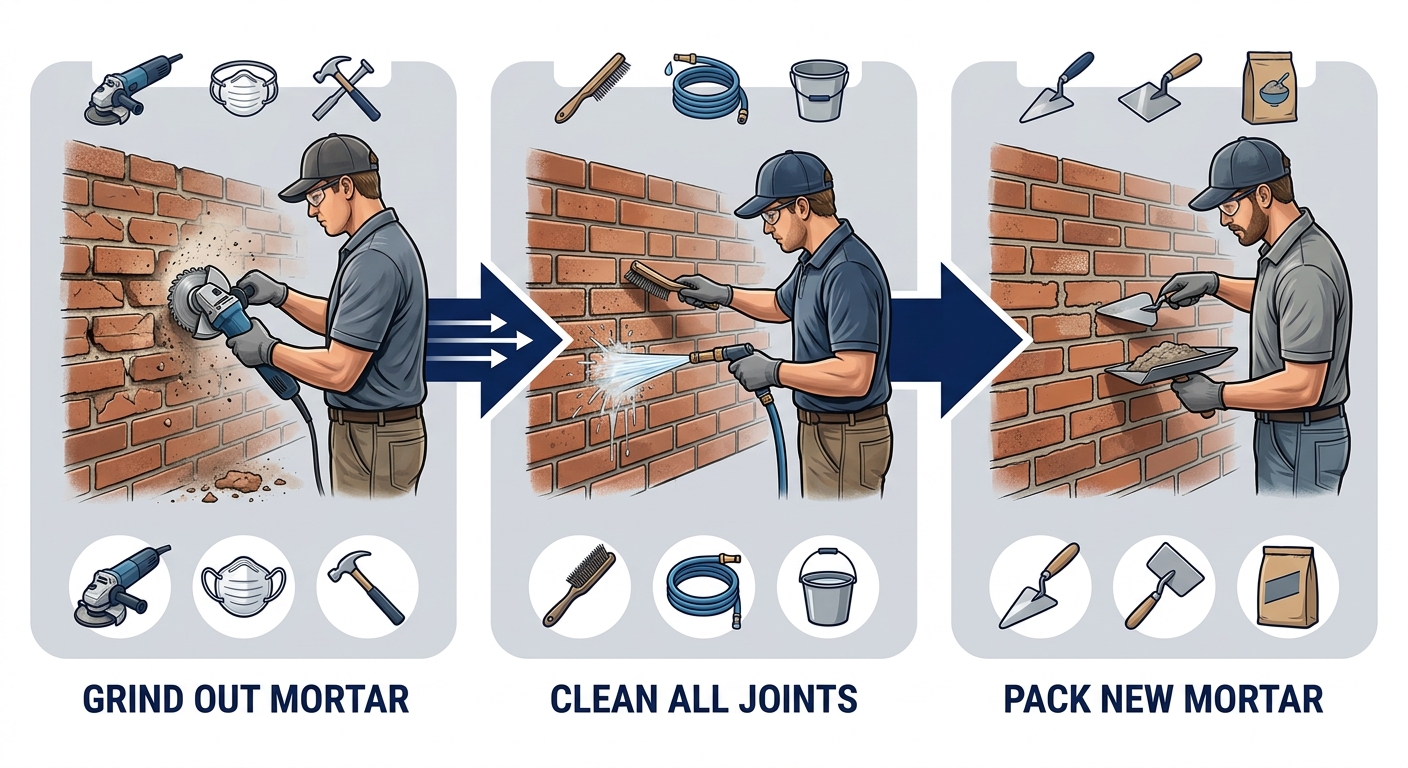
Three-step tuckpointing process from grinding to restoration
This methodical repair does more than just fill holes–it restores the wall’s water resistance. Fresh mortar forms a dense, uniform, watertight seal that directs rain back to the exterior, protecting your wood framing from moisture and preventing freeze-thaw spalling. For homeowners searching for a reliable solution, looking up brick repair near me will connect you with professionals who can restore your home’s integrity. While repointing brick cost per square foot varies based on the extent of damage and accessibility, B&G Tuckpointing believes in absolute transparency; we provide free, no-obligation custom quotes tailored to your exact project so you never face surprises. For localized trouble spots, our spot tuckpointing service offers a cost-effective alternative that still meets our rigorous standards for color-matching and durability.
We aim to enhance the appearance and improve the integrity of your house or building. B&G’s mission is to provide residential and commercial customers with an outstanding level of service, and with 20 years of experience, a nationwide footprint, and accessible in-house financing, we make it simple to act before small cracks grow into structural emergencies. Don’t let crumbling mortar dictate the lifespan of your home–Get A Quote today and let our team preserve the walls that keep you safe.
Diagnosing Mortar Problems and Estimating Repair Costs
If you’ve noticed brick mortar falling out from your walls or chimney, it’s important to assess the damage early. Deteriorating mortar is not just an eyesore; it can compromise your home’s weather resistance and allow water to seep behind the brickwork. At B&G Tuckpointing, we aim to enhance the appearance and improve the integrity of your house or building, and diagnosing problems correctly is the essential first step. The Brick Industry Association sets the technical standard for evaluating such damage, providing guidelines that we use to inspect and restore brickwork properly.
How to Perform a Simple Home Inspection
Before worrying about costs, take a flashlight and a simple tool like a flathead screwdriver or an ice pick and walk around your property. The objective is to identify weak joints early. Follow this simple checklist:
- Test the Hardness: Gently scrape the mortar joint. If it crumbles easily or you can dig in more than 1/4 inch, the mortar is weak and needs repointing.
- Check for Crumbling Mortar Between Bricks: Run the screwdriver along the horizontal and vertical joints. Powdery sand or pieces chipping away indicate the binder has failed.
- Check for Cracks: Inspect for cracks wider than 1/16 inch along the joints. These tiny fissures allow moisture in and will widen during freeze-thaw cycles.
- Spot Efflorescence: A white powdery deposit on the brick face signals that water is moving through the masonry and evaporating, leaving salts behind.
- Examine for Spalling: If the brick faces themselves are flaking or popping off, moisture intrusion has reached a critical stage.
A quick walk around your St. Louis area foundation and chimney can reveal a lot, but the Brick Industry Association’s technical notes remind us that surface problems often hint at deeper joint deterioration.
Understanding Repointing Costs Per Square Foot
When estimating your repointing brick cost per square foot, keep in mind that pricing hinges on far more than just mixing mortar. While cost varies significantly based on geography–project rates in a metropolitan hub like St. Louis, MO, differ from those on the coast–labor consistently dominates the budget.
The most significant cost drivers we encounter involve accessibility. Repointing a walk-out wall at ground level is far simpler than repairing mortar on a second-story facade or at the top of a chimney. These elevated areas require scaffolding, safety equipment, and more time to protect your landscaping and roofing. Chimney repair, in particular, often demands specialized ladder rigging and strict fall protection protocols.
Material selection also influences the total project. Accurately matching historic mortar color and texture requires specialized mixes. B&G’s mission is to provide residential and commercial customers with an outstanding level of service, which is why we handle our own color matching in-house. Because every project is unique, B&G provides a custom quote after an on-site inspection. Factors like mortar type, matching existing color, and the extent of damage all play a role; we don’t quote generic square-foot pricing without thoroughly reviewing the wall’s condition.
Choosing Between Spot Tuckpointing and Full Repointing
Once you identify the damaged areas, the decision comes down to scope: do you need spot tuckpointing, or is it time for a full repointing? The answer depends on the extent of damage, your budget, and your long-term aesthetic goals.
Spot tuckpointing targets only the visibly cracked or missing mortar. It is ideal when damage is localized–in our experience, if damaged joints cover less than 20% of a wall or chimney face, spot tuckpointing may be sufficient. This approach is less expensive immediately and causes less disruption, but it requires significant skill in color matching to blend the new mortar perfectly with the old. Our 20 years of experience in St. Louis ensures patches age uniformly with the surrounding brickwork.
Full repointing, on the other hand, involves grinding out and replacing all the mortar joints on a wall or chimney structure, regardless of current condition. This is the best investment when deterioration is widespread or when you want a perfectly uniform appearance. Although it is a larger job, full repointing delivers longer-lasting structural integrity, effectively resetting the waterproofing layer of your masonry. If your inspection reveals extensive damage, a full repointing ensures lasting results and a consistent facade. If you’re unsure which option fits your situation, professionals can assess the overall stability and advise on the best path forward–simply look up tuckpointing near me to discuss your specific project needs.
In the next section, we’ll walk you through how B&G handles a full tuckpointing project, from the initial quote to the final cleanup, so you know exactly what to expect.
Protecting Historic Brickwork and Preventing Future Mortar Failure
Now that we understand why mortar fails, let’s explore how to protect historic brickwork and prevent future damage. Discovering brick mortar falling out of your historic walls can be alarming, but the good news is that with the right approach, ongoing deterioration is entirely preventable. As a professional tuckpointing contractor, we focus on identifying root causes and applying solutions that preserve both structural integrity and visual character.
Moisture infiltration is the single biggest threat to historic mortar joints. When water penetrates porous brick and freezes during winter months, it expands and breaks the surrounding mortar apart–a process called freeze-thaw cycling. Crumbling mortar between bricks is a classic sign of this moisture-driven damage cycle. Over time, repeated freezing and thawing push out chunks of mortar, leaving gaps that invite even more water. In historic structures, the problem is compounded by the brick itself: older brick units are significantly softer than modern equivalents and can be permanently damaged by repairs done with hard, modern mortars.
Prevention starts with selecting the correct mortar composition. Historic brickwork demands low-strength mortars–typically lime-based or Type O–that stay softer than the surrounding brick. When movement or thermal stress occurs, the mortar gives way before the brick does, preventing unsightly and costly spalling. Our spot tuckpointing and color-matching service removes only the damaged material and replaces it with a historically appropriate blend, safeguarding the original brick. Beyond mortar choice, effective drainage is critical. Proper flashing, gutter maintenance, and grading that slopes soil away from the foundation channel water away from the wall assembly. We also apply breathable waterproofing sealants that allow trapped moisture to escape, stopping further freeze-thaw harm without locking vapor inside.
We recommend annual visual inspections to catch hairline cracks early. A small mortar fracture today can turn into a structural concern within a single winter. While DIY repointing may seem tempting, we consistently advise against using Portland cement on historic walls; it is too rigid, traps moisture, and is a known accelerant to brick decay. The Brick Industry Association’s technical notes–the authoritative industry standard for mortar selection–underscore that lime-based repointing is essential for longevity. By following these guidelines, every tuckpointing and waterproofing project we undertake adheres to proven best practices that honor the original craftsmanship.
Selecting the right mortar is the foundation of any lasting preservation effort, and this comparison illustrates why a one-size-fits-all approach rarely succeeds on older masonry. Lime putty mortars offer unmatched breathability, while Type O formulations strike a balance between workability and protection for softer brick. Even a moderately rated Type N mix introduces risks if the original brick cannot tolerate the additional strength.
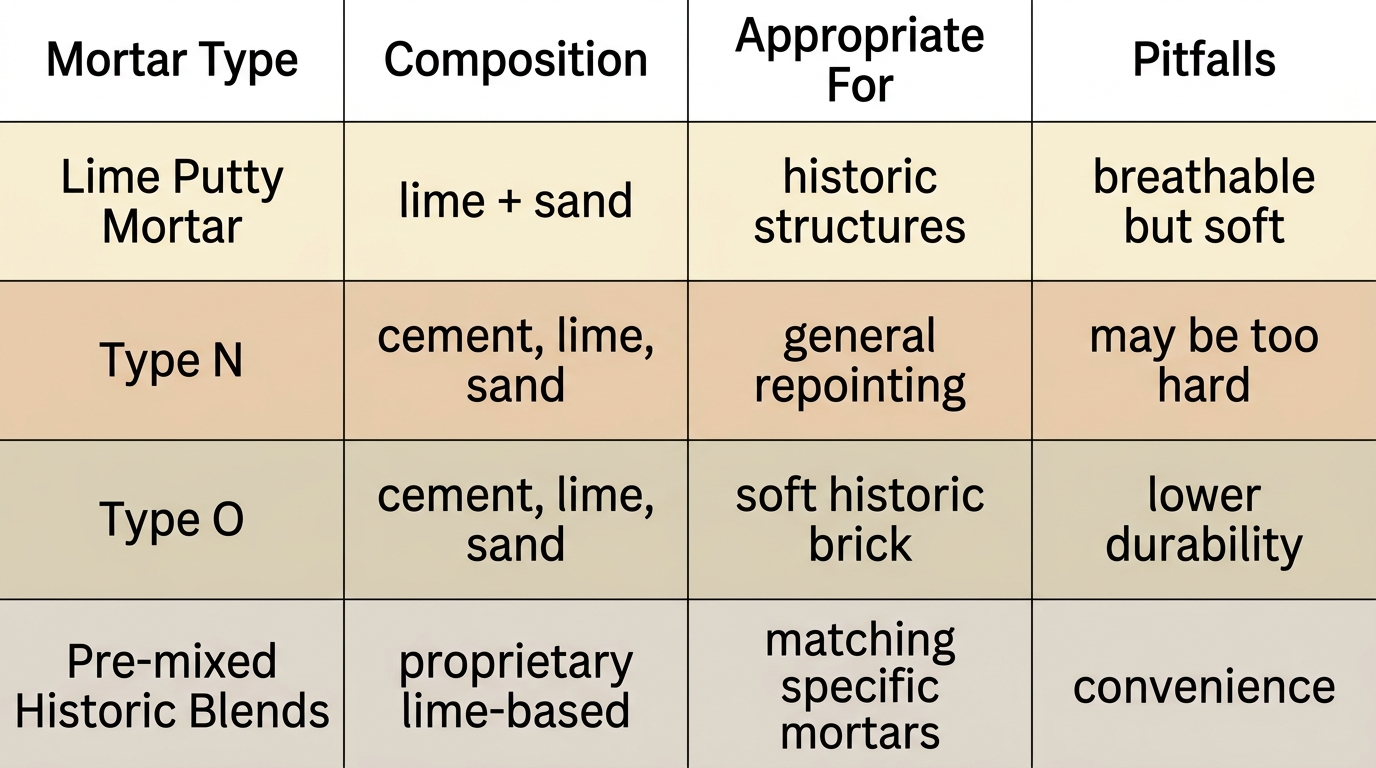
A comparison of four mortar types for historic brickwork, highlighting their composition, appropriate uses, and pitfalls.
A comparison of four mortar types for historic brickwork, highlighting their composition, appropriate uses, and pitfalls.
We aim to enhance the appearance and improve the integrity of your house or building through meticulously applied prevention principles. Whether you are addressing a single cracked joint or safeguarding an entire historic facade, our team applies these proven techniques on every job. Learn more about our detailed tuckpointing and waterproofing process in the following sections, and contact us for a personalized estimate.
Frequently Asked Questions About Mortar Deterioration
Why is the mortar between my bricks crumbling?
Moisture exposure and age-related wear are the two main causes. According to Brick Industry Association guidelines, freeze-thaw cycles and improper curing can accelerate deterioration, leading to brick mortar falling out from your wall.
Is crumbling mortar a serious problem?
Yes. Left untreated, deteriorating joints allow water penetration that can lead to brick displacement and extensive structural damage. Prompt tuckpointing prevents these costly escalations.
Can I fix it myself?
We strongly advise against DIY repointing for anything beyond tiny cosmetic fixes. An improper mortar mix or application technique often worsens the damage, creating a larger repair bill later.
What does B&G’s tuckpointing process involve?
We start with an assessment, remove deteriorated mortar, precisely color-match new mortar, and apply it carefully. We provide reliable tuckpointing nationwide with free estimates. B&G’s mission is to provide residential and commercial customers with an outstanding level of service, and each step is designed to restore your masonry’s integrity and appearance. Contact us for a custom quote tailored to your property.
Restore Your Brickwork with Confidence
Noticing brick mortar falling out or crumbling mortar between bricks can be worrying, but it’s a common issue that professional restoration can fix. Following Brick Industry Association technical standards, our team strengthens weakened structures while preserving your building’s appearance and protecting against future water infiltration problems. With 13 years of masonry experience serving property owners in St. Louis, MO and nationwide, we guide you through every step of the repair process, including inspection, repairs, and final cleanup. That’s where our tuckpointing services come in.