
Table of Contents
Commercial Tuckpointing: Protecting Your Building Investment
When mortar joints fail on a commercial property, water seeps in and triggers freeze-thaw cycles that spall bricks and cause serious structural decay. Deferred maintenance often snowballs into exponentially higher repair bills. That’s why commercial tuckpointing is more than routine maintenance–it’s a critical safeguard for your building investment.
According to the Brick Industry Association, professional repointing brick joints can add 20-30 years to a masonry structure’s usable life. For commercial buildings, that longevity requires a crew skilled in large-scale logistics, safety compliance, and minimal downtime. Our commercial masonry services are designed to protect your building investment while keeping your business running smoothly. We bring over 20 years of hands-on experience–backed by genuine customer care and our St. Louis roots–to every project. With our nationwide reach, you get the same high-quality work whether your building is in St. Louis or across the country. Masonry restoration for commercial structures not only stops water damage but also revitalizes curb appeal and property value, attracting tenants and customers. We aim to enhance the appearance and improve the integrity of your building. We service tuckpointing clients nationwide and offer in-house financing to make even large projects manageable.
Ready to see the difference expert commercial tuckpointing can make? Get A Quote today, and let’s discuss how we can extend the life of your building and keep it looking its best.
The Basics of Commercial Tuckpointing
Now let’s look at the basics of commercial tuckpointing. In commercial tuckpointing, we address the unique challenges of large-scale brick structures to prevent water intrusion and maintain structural integrity.
This proactive maintenance saves building owners from costly repairs and extends the lifespan of their property. At B&G Tuckpointing, we’ve spent over a decade helping clients understand these essentials.
Commercial tuckpointing, also known as brick repointing, is the process of removing deteriorated mortar from brick joints and replacing it with fresh, high-strength material. The Brick Industry Association advises using mortar mixes like Type S or Type N for commercial walls, which must withstand higher loads and taller spans. According to the International Masonry Institute, proper joint preparation and tooling are critical for long-term performance, especially when scaffolding and OSHA safety regulations come into play; without solid mortar joints, water seeps behind bricks, causing freeze-thaw damage and interior leaks that can escalate quickly.
Residential tuckpointing typically prioritizes color-match and minor crack repairs for curb appeal, while commercial tuckpointing focuses on longevity and structural integrity. Commercial buildings bear greater loads and face more exposure, so we use harder mortar and comprehensive inspections to uncover hidden damage. The scale distinction is significant: commercial projects involve multi-story scaffolding, a team of specialists, and strict adherence to safety standards that go well beyond residential work; even small mortar failures can compromise insulation and lead to costly water infiltration, making commercial tuckpointing a wise investment for long-term property value.
A commercial tuckpointing project starts with a detailed joint inspection to chart deteriorating areas. Our crew then grinds out old mortar to a uniform depth, cleans the cavity, and mixes new mortar to match the original’s strength, texture, and color. The fresh mortar is pressed and tooled into a weather-resistant profile that sheds water effectively, and when performed correctly, this process becomes a cornerstone of a broader masonry restoration plan that prevents minor cracks from escalating into structural threats; moreover, proper tuckpointing can improve your building’s thermal efficiency and raise its market value, making it a smart long-term decision.
For comprehensive facade protection, explore our solid tuckpointing services; our mission is to provide residential and commercial customers with an outstanding level of service, and we aim to enhance the appearance and improve the integrity of your commercial building. We service tuckpointing clients nationwide and offer in-house financing. Understanding these basics is the first step toward preserving your commercial property–next, we’ll walk through the actual process.
Understanding Commercial Tuckpointing in Depth
Now let’s dive deeper into what affects the cost of commercial tuckpointing, how long the work holds up, and why staying on schedule with tuckpointing protects your building. Before we explore those details, it’s helpful to understand how commercial tuckpointing compares to related services like brick repointing and masonry restoration. The following table clarifies the differences in scope, cost, and application. Understanding these distinctions helps you choose the right approach for your building’s condition and budget.
| Aspect | Commercial Tuckpointing | Brick Repointing | Masonry Restoration |
|---|---|---|---|
| Primary Focus | Aesthetic and protective mortar refresh | Replacing deteriorated mortar joints | Comprehensive structural and cosmetic renewal |
| Typical Cost per Sq Ft | $$ (mid-range) | $ (lower) | $$$ (higher) |
| Ideal For | Buildings with sound brick but worn mortar | Facades needing basic mortar repair | Historic or extensively damaged structures |
| Craftsmanship Level | Skilled (color match & precision) | Moderate | High (advanced techniques) |
Sources: Brick Industry Association guidelines for masonry repair; Association for Preservation Technology International best practices for historic masonry.
With this context, let’s examine the specific factors that influence the cost of a commercial tuckpointing project.
Cost Factors for Commercial Tuckpointing
Several variables shape the per-square-foot cost of a commercial tuckpointing project. Building height plays a significant role; multi-story structures require extensive scaffolding or boom lifts, while single-story buildings are simpler to access. Mortar complexity is another key factor. If your building needs a custom color match to preserve its original aesthetic, the process is more labor-intensive than using a standard mortar mix. Accessibility challenges, such as tight urban spaces or overhead obstructions, can also increase the time and equipment needed. Finally, the extent of the repairs–whether it’s full-wall tuckpointing or spot repairs on a few deteriorated joints–affects the total investment. We serve clients nationwide and offer in-house financing to make commercial tuckpointing projects manageable. For a precise assessment of your building’s needs, contacting a tuckpointing company near me ensures you get an accurate custom quote.
Expected Lifespan of Professional Tuckpointing
When performed by experienced professionals, commercial tuckpointing typically lasts 15 to 25 years. The Brick Industry Association notes that proper mortar mix selection and meticulous workmanship are the primary determinants of longevity. Climate is another critical variable–buildings in regions with frequent freeze-thaw cycles often experience accelerated mortar wear, shortening the effective lifespan. For instance, a building in the Midwest may require tuckpointing sooner than one in a milder coastal climate. At B&G Tuckpointing, we use high-quality materials and proven techniques to maximize durability, even in challenging environments. We help clients in all climates by tailoring our mortar mixes to local conditions, ensuring the repair stands up to whatever Mother Nature delivers. This commitment helps your building’s facade stay protected and attractive for decades.
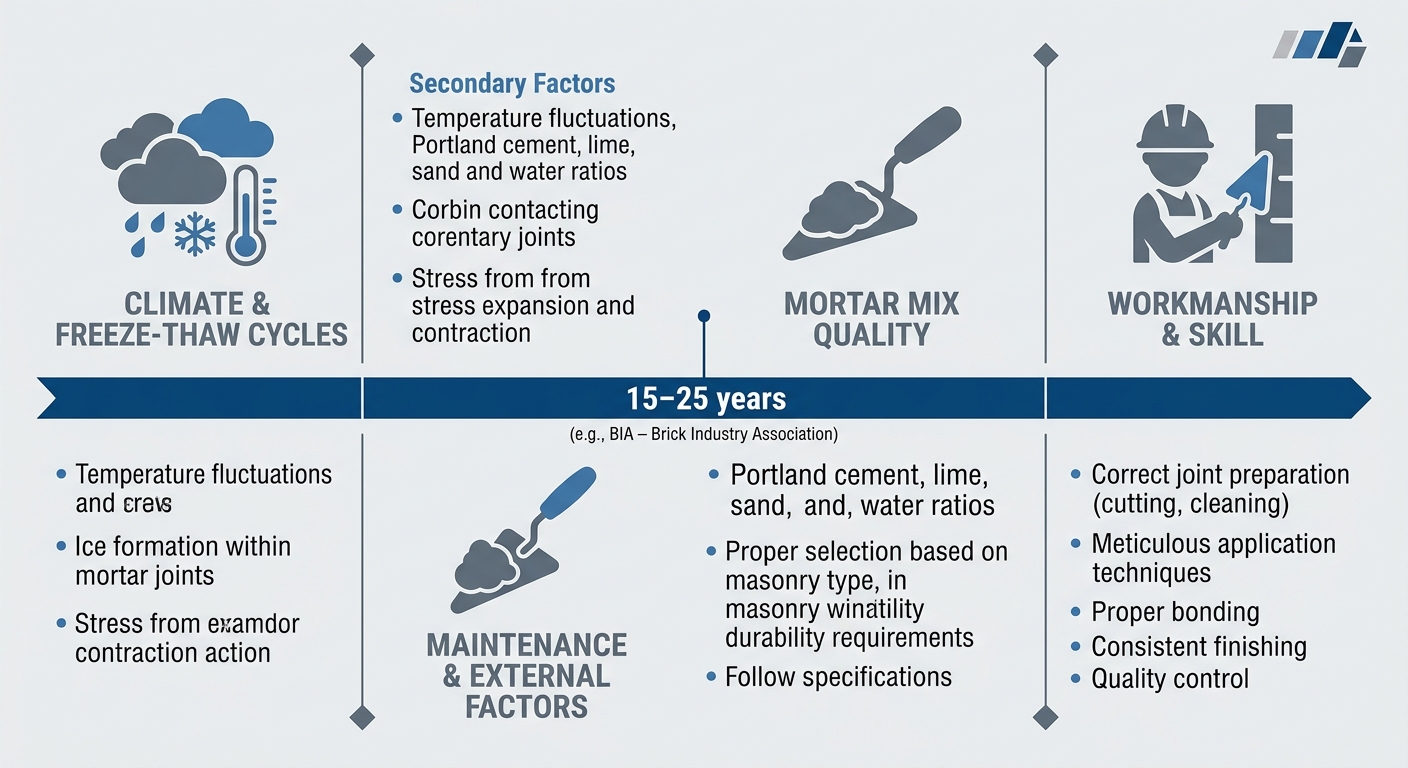
15-25 year commercial tuckpointing lifespan visualized
By investing in professional commercial tuckpointing now, you not only improve your building’s curb appeal but also avoid the higher costs of extensive masonry repairs down the road.
Why Timely Tuckpointing Preserves Structural Integrity
When tuckpointing is delayed, moisture finds its way behind the bricks, leading to a cascade of problems. According to the Association for Preservation Technology International, water infiltration can cause bricks to spall–crack, flake, or break apart–as well as unsightly efflorescence and gradual weakening of the wall assembly. Moisture intrusion can even damage interior finishes and foster mold growth, creating health risks for occupants. Left unchecked, these issues can compromise the building’s structural integrity and require far more expensive full-wall reconstruction. Timely commercial tuckpointing seals mortar joints before deterioration spreads, protecting against water damage and preserving the masonry’s load-bearing capacity. We complement tuckpointing with waterproofing and caulking to create a comprehensive moisture barrier. By addressing mortar deterioration early, you maintain a safe and structurally sound building while avoiding these costly consequences. Our team at B&G Tuckpointing approaches every project with the goal of enhancing your building’s appearance while safeguarding its long-term stability.
With a solid understanding of the cost drivers, longevity, and structural benefits of commercial tuckpointing, you’ll be ready to explore the step-by-step process we follow to deliver lasting results.
Making Commercial Tuckpointing Work for Your Property
When aging mortar appears on your commercial building, prompt action preserves safety and curb appeal. B&G Tuckpointing tailors commercial tuckpointing to your property’s unique materials. We aim to enhance your building’s appearance and improve its structural integrity. With over a decade of expertise and nationwide service, we help prevent water damage and structural decline.
Signs Your Commercial Building Needs Tuckpointing
Catching masonry issues early can save your business from emergency repairs. Common signs include cracked or crumbling mortar joints that allow moisture behind the brickwork. Efflorescence–a white, powdery substance on the wall–indicates water moving through the mortar. Spalling bricks, where the brick face flakes away, signal deeper water penetration that weakens the assembly. Loose bricks, gaps around openings, and general deterioration are additional red flags. Ignoring these signs can lead to costly structural failures and interior water damage. That’s why it’s crucial to partner with a knowledgeable tuckpointing contractor who understands commercial masonry. We provide thorough on-site assessments and photo-based estimates so you know exactly what needs to be addressed. Early intervention with our color-matched mortar can restore the wall’s original look while stopping deterioration. Contact us at the first sign of trouble for a professional evaluation.
Permit Requirements for Commercial Tuckpointing
Masonry restoration on commercial buildings often requires local permits, especially for structural or exterior work. According to the International Code Council, repointing projects may need a permit if they affect load-bearing walls or exterior appearance. We handle these requirements for you, ensuring your project complies with all applicable codes. Our nationwide experience lets us navigate varying municipal rules and coordinate with officials to keep things on track. Securing permits upfront prevents costly stop-work orders and fines. If you’re unsure whether your facade work needs a permit, our initial consultation includes a detailed code review. We also guide you through any special historic district or masonry restoration regulations that may apply. Our team’s experience with both modern and historic structures ensures all necessary approvals are secured before work begins.
The table below outlines common tuckpointing methods for commercial structures, informed by the International Masonry Institute. We evaluate your building’s condition to recommend the best approach.
| Method | Best For | Typical Cost | Longevity |
|---|---|---|---|
| Solid Tuckpointing | Entire facade with uniform mortar wear | $$$ | 15-25 years |
| Spot Tuckpointing & Color Match | Localized damaged areas | $$ | 10-20 years (area‑dependent) |
| Full Brick Repointing | When mortar joints are deeply failing | $$-$$$ | 20-30 years |
Solid tuckpointing refreshes the whole facade. Spot and color matching tackle isolated damage affordably. Full repointing (brick repointing) addresses deep mortar failure and can last 20-30 years. Cost and longevity are estimates; we tailor a custom quote and offer in-house financing.
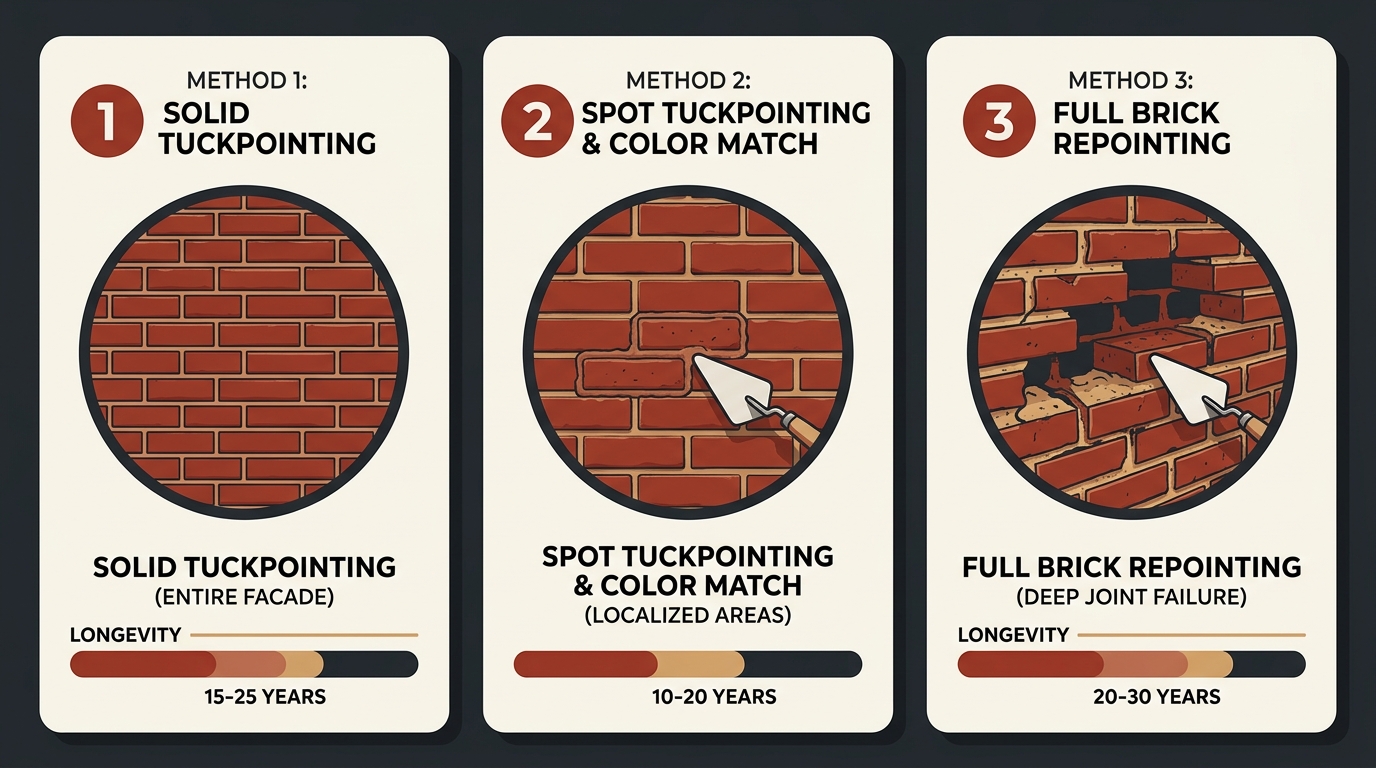
Comparison of three commercial tuckpointing methods
With your masonry restored, a regular inspection routine helps prevent future surprises. Here’s our recommended schedule.
Recommended Inspection and Maintenance Schedules
We recommend an annual professional masonry inspection for all commercial properties to catch minor cracks before they widen. During the checkup, we look for moisture intrusion, joint deterioration, and any loose bricks. A preventive maintenance cycle every five years–including sealant reapplication and touch-up pointing–works well for most buildings. Harsher environments may need more frequent reviews. We customize a maintenance plan suited to your building’s age and location. Proactive care extends facade lifespan and helps you budget for future restorations. Our nationwide service and photo-based remote estimates make getting started easy. Regular maintenance preserves curb appeal and can be scheduled around your business operations. Contact B&G Tuckpointing for a custom quote and ask about our in-house financing to make your project affordable. Our team looks forward to keeping your building strong for years to come.
Advanced Techniques in Commercial Tuckpointing
While standard commercial tuckpointing covers most projects, historic masonry restoration requires a specialized approach. Whether you’re managing a modern commercial property or a treasured historic landmark, the approach to tuckpointing varies significantly. Understanding the distinctions between these advanced techniques ensures you select the right method for your building’s unique needs. At B&G Tuckpointing, we apply both modern and historic methods to deliver durable, visually seamless results for every client.
The comparison below outlines the key differences in materials, expertise, and regulatory requirements between standard commercial tuckpointing and historic masonry restoration.
| Factor | Standard Commercial Tuckpointing | Historic Masonry Restoration |
|---|---|---|
| Mortar Type | Modern cement‑based | Lime‑based matches original |
| Skill Requirements | General tuckpointing expertise | Specialized historic training |
| Typical Permit Scrutiny | Standard building permits | Often stricter (landmark review) |
| Cost | $$-$$$ | $$$-$$$$ |
Mortar composition is the foundation of any tuckpointing project. According to the Association for Preservation Technology International, historic buildings require lime-based mortar that matches the original material to prevent damage from incompatible modern cement. Standard commercial tuckpointing, in contrast, uses durable cement-based mortar suited for contemporary structures. This distinction is critical for proper brick repointing and long-term masonry restoration.
Skill requirements also diverge significantly. As the International Masonry Institute emphasizes, historic restoration demands specialized training–often including historic masonry certification–to handle delicate older brickwork. General tuckpointing expertise is sufficient for standard commercial tuckpointing, but we ensure every team member is well-versed in both approaches.
Permit scrutiny is another area of difference. Historic projects frequently involve landmark review boards, adding layers of regulatory oversight that standard commercial tuckpointing–typically requiring only standard building permits–avoids. This heightened review, combined with the higher cost of lime-based materials and expert labor, places historic restoration in a premium price range ($$$-$$$$) compared to standard work ($$-$$$).
Mastering these advanced techniques ensures long-lasting results–whether for a full restoration or targeted repairs. Our team brings over a decade of experience to nationwide tuckpointing projects, ensuring quality craftsmanship on every job. B&G’s mission is to provide residential and commercial customers with an outstanding level of service, and we bring that commitment to every project. We Service Tuckpointing Clients Nationwide & Offer In-House Financing! For commercial tuckpointing nationwide, contact B&G Tuckpointing for a custom quote. Get A Quote today to discuss your masonry needs.
Frequently Asked Questions About Commercial Tuckpointing
Now that you understand the commercial tuckpointing process, let’s answer common questions building owners often have.
What is commercial tuckpointing and why is it necessary?
It restores mortar joints for structural safety. We aim to enhance the appearance and improve the integrity of your building, following ICC codes and BIA guidelines. Our commercial tuckpointing process matches mortar color and maintains brickwork.
How do I know if my building needs tuckpointing?
Watch for crumbling mortar, water stains, or spalling bricks. A professional inspection identifies hidden damage and suggests brick repointing or full masonry restoration to prevent moisture intrusion.
Can tuckpointing be done while the building is occupied?
Yes. We work nights and weekends with safety barriers, minimizing disruption so business continues smoothly.
Does commercial tuckpointing require permits?
Yes. We help navigate local St. Louis code requirements based on ICC standards, ensuring compliance for your project.
How much does commercial tuckpointing cost?
Costs vary by building size, mortar type, and access. Contact us for a custom quote without obligation.
How do I find a qualified contractor?
We service clients nationwide. When searching for “tuckpointing near me,” choose trustworthy tuckpointing near me to ensure code-compliant results.
Contact us for a custom quote and let our 20 years of masonry experience protect your commercial property.
Preserving Your Commercial Building with Timely Tuckpointing
Commercial property owners nationwide rely on timely commercial tuckpointing to preserve structural integrity and meet building code requirements.
The International Code Council (ICC) sets standards that mandate proper mortar joint maintenance to prevent water intrusion and decay. Neglecting needed brick repointing often leads to costly masonry replacement, code violations, and physical safety hazards.
Regular masonry restoration extends a building’s service life by decades while enhancing overall property value. We perform all commercial work to ICC standards, allowing you to rest easy that your investment is protected. We encourage you to contact us for a detailed assessment.